Apologies for the interruption in coverage; I have a good excuse, henceforth known as The Agent (of both the ‘defying the Principal’ variety and the fast-learning natural/artificial variety).
links
papers
-
McCartan and Kuriwaki revisit the ecological inference problem of estimating granular measurements (say, conditional means) when only aggregate quantities are observed. Clear statements of identification assumptions (Coarsening at Random is the magical fairydust in the literature analogous to Unconfoundedness) and encompassing exposition of the fragmented literature, representation as a linear functional which enables the use of automatic debiased machine learning methods and accompanying sensitivity analysis, etc.
-
Crippa and Fedchenko on the identification of ranking/reward models from pairwise comparisons data. Nice exposition of connections between Bradley-Terry-Luce and discrete choice models widespread in econometrics.
-
Van der Laan et al on a tractable approach to estimate Inverse Reinforcement Learning (IRL) models, which learn reward functions from observed offline behaviour [assumed to be generated by an expert/optimizing agent]. This last point should make it amply clear that this is identical to the problem of learning structural parameters in economic models [e.g. discrete choice models of static and dynamic varieties, estimating games, etc.]. Related: Chelsea Finn’s bootcamp slides
code, music
-
ssh-list is a good tui for managing ssh connections.
-
ivmodels looks like a well-designed and thorough package for IV and related methods (k-class, LIML).
-
Joel Grus’ very on-brand Clod - dspy is now so powerful that you can just leave it in charge of your computer until it tries to delete the french language pack
rm -fr /. -
Igorrr’s new album is fantastic. Eclectic Baroque glitch electronic metal with nods to Mick Gordon’s doom soundtracks and Hans Zimmer’s dune soundtracks.
self-promotion
-
arxivdiff lets you diff papers on arxiv by creating temp git repositories and visualizing latex source diffs in a web UI. I use it a lot.
-
Apropos of the top of this post, the Agent is healthy and growing at a frankly alarming clip. If we know each other IRL, feel free to ping me for photos; new parents love inflicting baby photos on others and turns out I’m no different.
Adversarial Estimation of Statistical Models
Kaji, Manresa, and Pouliot propose adversarial estimation for structural models whose likelihood is intractable but whose simulator is available. Sohn and Song propose a parallel-tempering construction for stabilizing Wasserstein GANs trained on multimodal targets. The two ideas fit together, but not by simply replacing one optimizer with another: the loss, the object generated, and the statistical guarantees all change.
The original adversarial estimator is a profiled JS estimator
Let be the observed data. The structural model is a family represented by a simulator
where the shocks are drawn once and held fixed across candidate values of . If is the probability that is observed rather than simulated, Kaji, Manresa, and Pouliot define
With unrestricted discriminators and densities and , the population inner solution is
Substitution gives
Thus the original estimator really does use Jensen—Shannon divergence at the population oracle. It is important, however, to distinguish the statistical estimator from the usual alternating GAN training loop. Kaji, Manresa, and Pouliot profile the discriminator: for each candidate , train nearly to completion, evaluate the resulting criterion, and then update . Their efficiency results concern that profiled criterion, not an arbitrary sequence of simultaneous generator and discriminator steps.
The JS representation also explains the optimization problem. When and have disjoint supports, is locally flat. A nearly perfect discriminator then supplies little useful gradient for .
Wasserstein adversarial estimation
The Wasserstein replacement uses the Kantorovich—Rubinstein dual:
The structural estimator becomes
where approximates a class of 1-Lipschitz functions. Unlike JS, continues to measure how far separated supports are. WGAN-GP enforces the Lipschitz restriction approximately by penalizing
This changes both the geometry and, under misspecification, the pseudo-true parameter. The parametric-efficiency theorem for the oracle JS discriminator does not automatically transfer to a Wasserstein estimator.
Parallel tempering for a structural simulator
For two independent observed draws and two independent simulator draws, define
Intermediate values of fill the convex hull between modes. Because , both networks receive the symmetric temperature feature
Following Sohn and Song, sample temperatures from
The point mass at keeps the original distribution prominent while the continuous component supplies easier, less multimodal bridges. The natural parallel-tempered structural criterion is the joint integral probability metric
This is an IPM between the joint laws of and ; it is not generally a scalar weighted average of separately optimized Wasserstein distances.
Correct specification makes the construction safe at the population level. If , then at every temperature, so . Conversely, if and the critic class can distinguish the endpoint laws, equality of the joint laws implies equality at the atom , hence . Identification of therefore carries over under correct specification. Under misspecification, the extra temperatures reweight distributional discrepancies, so the pseudo-true parameter need not equal either the JS or ordinary Wasserstein projection.
The full PTGAN adds a coherency penalty. Draw , , and ; form
The critic maximizes the tempered discrepancy minus
This directional-derivative penalty synchronizes the critic along temperature paths, with longer between-mode chords receiving more weight. It is not merely an ordinary gradient penalty applied to mixed observations.
For structural estimation, must be constructed by mixing two simulator outputs. Interpolating the primitive shocks and then applying is equivalent only when the structural transformation is affine. The alternating algorithm is:
- Draw observed and simulated pairs, a temperature , and the auxiliary temperatures for the coherency penalty.
- Update the critic using the tempered discrepancy and coherency penalty.
- Holding the updated critic fixed, differentiate through the structural simulator and update .
- Repeat with common simulation shocks.
Why the logistic-location toy is uninformative about tempering
The original illustration used the location family . Its tempered simulator is
Every temperature contains exactly the same location parameter. The model is unimodal, the oracle discriminator has a two-parameter closed form, and profiling it is easy. Parallel tempering has no mode-collapse problem to solve. It can alter Monte Carlo variance, but it contributes no new population identification of .
A useful stress test needs a multimodal implicit model while retaining a low-dimensional structural parameter. Consider
The parameter is the radius of an eight-component Gaussian mixture. The experiment sets and initializes the simulator at . Conditional on the stored draws, the simulator is differentiable in .
Four alternating estimators receive the same 4,000 observations, 4,000 fixed simulation shocks, two-hidden-layer 64-unit critic, batch size 100, three critic updates per parameter update, Adam learning rates, and 20 paired seeds:
- JS-GAN: the original minimax cross-entropy value, optimized by alternating updates rather than exact profiling;
- WGAN-GP: the ordinary endpoint Wasserstein objective with gradient penalty 10;
- Tempered-GP: convex tempering with , but an ordinary gradient penalty; and
- PTGAN-CP: convex tempering with and the Sohn—Song coherency penalty .
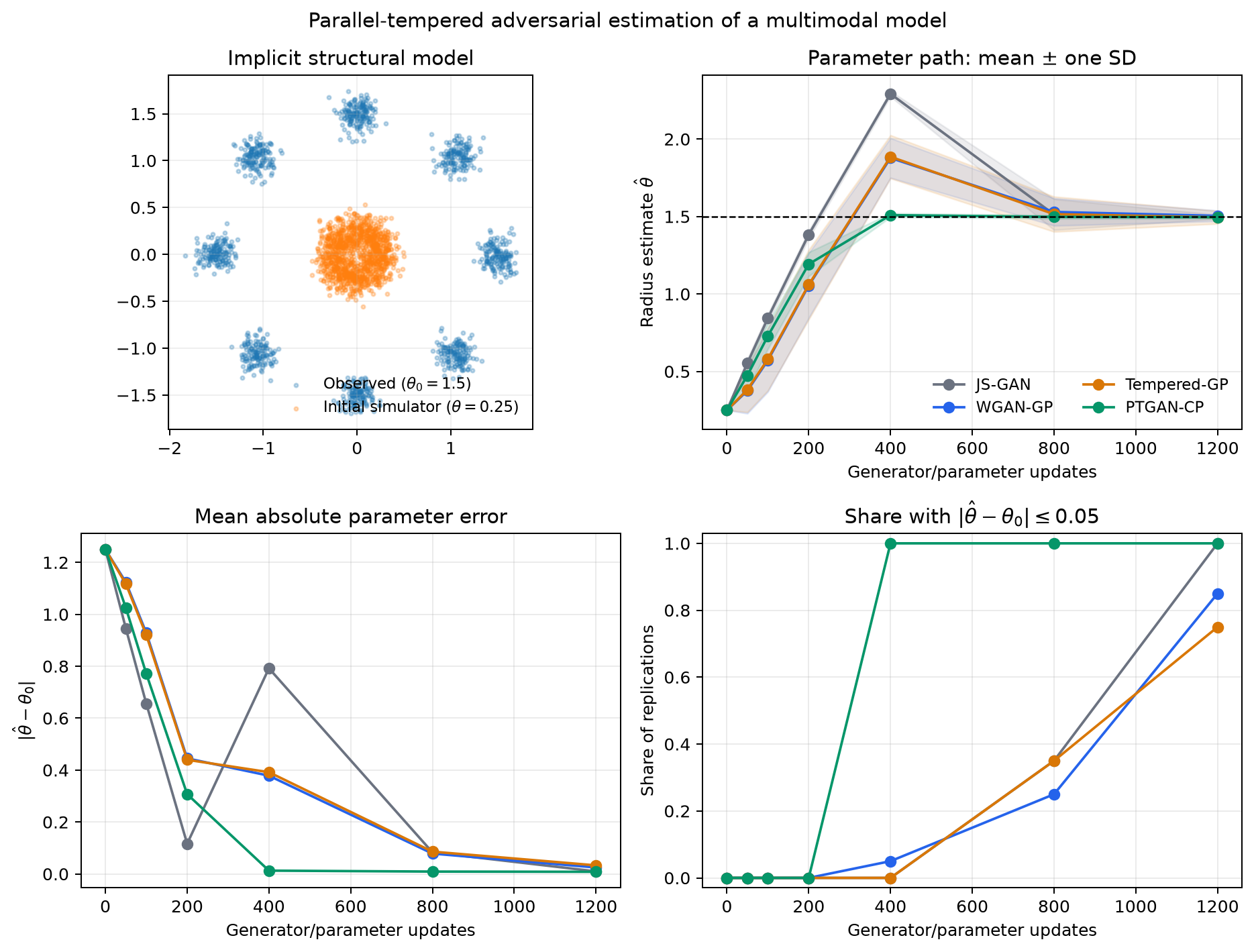
The table reports averages over the 20 paired replications. “Within” is the share satisfying .
| Estimator | , step 400 | MAE, step 400 | Within, step 400 | MAE, step 1,200 | Within, step 1,200 | Seconds, step 1,200 |
|---|---|---|---|---|---|---|
| JS-GAN | 2.292 | 0.792 | 0% | 0.0099 | 100% | 1.185 |
| WGAN-GP | 1.878 | 0.378 | 5% | 0.0249 | 85% | 1.610 |
| Tempered-GP | 1.886 | 0.392 | 0% | 0.0331 | 75% | 1.659 |
| PTGAN-CP | 1.509 | 0.0127 | 100% | 0.0082 | 100% | 1.677 |
The full PTGAN reaches the target more slowly in the first 200 updates, then stops at it. All three alternatives overshoot: at 400 updates the mean JS estimate is 2.29 and the two gradient-penalty estimates are about 1.88. PTGAN is within 0.05 in every replication by update 400 and remains there. Merely tempering the observations does not produce this result: Tempered-GP is essentially WGAN-GP. The coherency penalty is the operative part of the stabilization.
By 1,200 updates, JS-GAN has recovered and all methods are close on average, although WGAN-GP and Tempered-GP still miss the 0.05 band in 3 and 5 of the 20 runs. PTGAN costs about 42 percent more per 1,200 updates than JS-GAN because the penalty uses second-order automatic differentiation. Its time to a stable estimate is nevertheless lower in this example: update 400 takes about 0.56 seconds, while JS-GAN requires the full 1.18 seconds to recover from its overshoot.
This is evidence about optimization, not a new efficiency theorem. The radius model has an easy model-specific moment estimator, and the experiment deliberately creates a hostile multimodal objective to isolate training dynamics. A serious structural application still needs a population analysis of the tempered pseudo-true value, simulation-based inference that re-runs the entire minimax procedure, and sensitivity analysis over and .
The complete reproduction script, replication-level results, and summary table are available with the site source.