Poisson regression uses \mu_i=\exp(x_i'\beta+o_i), where o_i is a known offset, and minimizes \sum_i[\mu_i-y_i(x_i'\beta+o_i)] up to outcome-only constants. An exposure e_i enters as o_i=\log e_i; it is not another coefficient to estimate.
The coefficient of a continuous variable is a log-odds slope in logit and a log-mean slope in Poisson. It is not the same as an additive probability or count effect. For logit, \partial p_i/\partial x_{ik}=p_i(1-p_i)\beta_k.
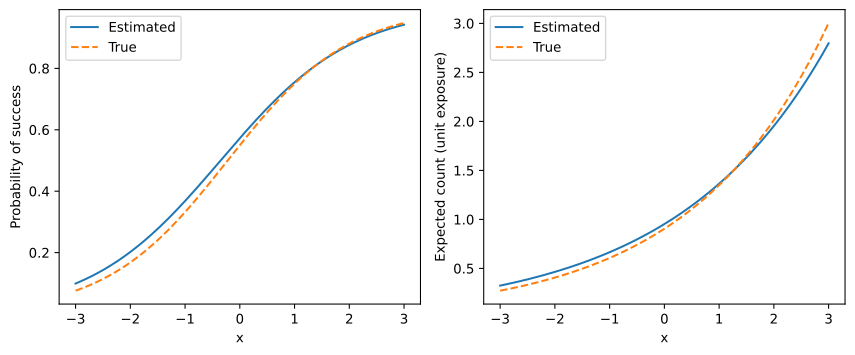
Estimated response curves. The Poisson curve uses unit exposure; it should not be compared to variable-exposure counts without adjustment.
LogisticRegression.predict returns a thresholded label; predict_proba returns the probability. PoissonRegression.predict returns the expected count, not a Poisson draw. Pass prediction-time offsets explicitly when exposure changes.
Additive effects and computational choices
These two GLM classes support fixed-effect ID blocks through fe, sparse incidence designs through fe_design, and offsets. The linear index becomes x_i'\beta+\sum_d\alpha^{(d)}_{g_d(i)}+o_i. Prediction must supply the matching FE inputs; unseen levels do not have an estimated effect. This is a likelihood fit with nuisance effects, not ordinary linear demeaning followed by a GLM.
The default optimizer is LBFGS. First-order optimizers can use batch_size for supported GLMs. stderr=False skips the information calculation when only fitting or prediction is desired. Sparse effects can reduce representation cost, but inference and nuisance blocks may still impose substantial memory costs.
Statistical qualifications
Model-based information is \sum_i p_i(1-p_i)x_ix_i' for ordinary logit and \sum_i\mu_i x_ix_i' for ordinary Poisson. These are not general heteroskedasticity/cluster-robust covariance estimators. A correct Poisson mean can motivate a quasi-likelihood point estimate under non-Poisson variance, but its reported model-based SE then needs separate justification.
Complete or quasi-complete separation can send binary-model coefficients toward infinity. Fixed effects with few observations per level introduce incidental-parameter concerns; no general bias correction is supplied. A large batch count or a small loss change does not resolve these statistical issues.