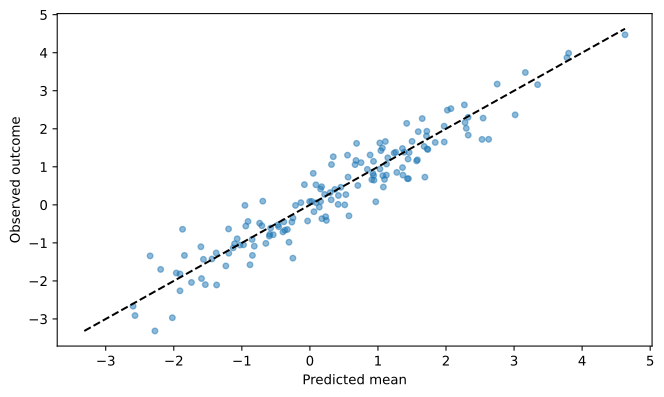
This example estimates a linear conditional mean, inspects uncertainty and evaluates predictions on observations excluded from fitting. It introduces the explicit design matrices and result containers used throughout the library.
Data and target
Let y_i=0.5+1.4x_{i1}-0.8x_{i2}+\epsilon_i, with mean-zero noise independent of the regressors. The slopes describe conditional associations here; a causal interpretation would require a substantive exogeneity argument.
Show Python
import numpy as npimport pandas as pdimport torchfrom trex import LinearRegressiontorch.set_num_threads(2)rng = np.random.default_rng(42)X = np.column_stack([np.ones(600), rng.normal(size=(600, 2))])truth = np.array([0.5, 1.4, -0.8])y = X @ truth + (0.3+0.2* np.abs(X[:, 1])) * rng.normal(size=600)train, test = np.arange(450), np.arange(450, 600)model = LinearRegression(device="cpu").fit(X[train], y[train], se="HC1")pd.DataFrame({"term": ["intercept", "x1", "x2"], "truth": truth,"estimate": model.params["coef"].numpy(),"HC1 SE": model.params["se"].numpy()}).round(4)
term
truth
estimate
HC1 SE
0
intercept
0.5
0.4704
0.0234
1
x1
1.4
1.3950
0.0308
2
x2
-0.8
-0.7599
0.0243
Trex does not add an intercept to LinearRegression; the first column above supplies it. HC1 permits heteroskedastic errors under independent sampling. It is not cluster-robust inference for dependent panel rows.
Held-out outcomes and predicted conditional means. Noise prevents perfect outcome prediction even when the mean model is correct.
Read results explicitly
Most regression and choice models store coefficients and standard errors in params. GMM instead exposes theta_ and covariance_; GEL uses est and Sigma; panel estimators expose result_. The selection guide and individual examples show these differences rather than implying a uniform scikit-learn interface.