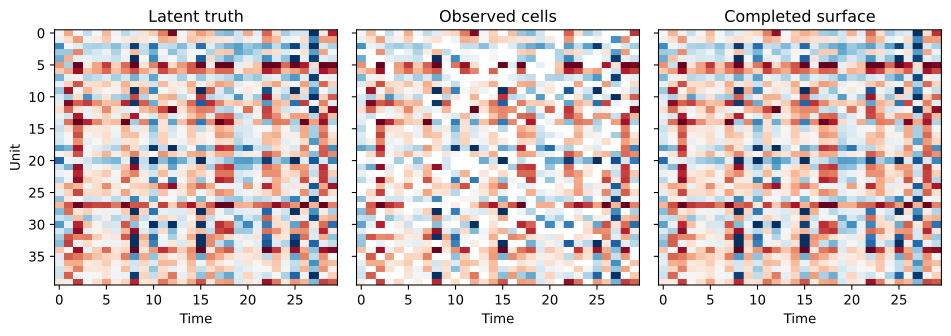
Recover a low-rank panel surface using only observed cells.
A model for an incomplete outcome surface
Write Y_{it}=a_i+b_t+L_{it}+\varepsilon_{it}, where L is approximately low rank. Shared latent factors allow observed cells to inform missing cells. Instead of choosing a rank and fitting factors directly, nuclear-norm regularization shrinks singular values:
Here \Omega is the training set and \|L\|_* is the sum of singular values. Trex alternates additive-effect updates with singular-value thresholding. An explicit lambda_L controls the penalty; otherwise lambda_fraction scales a data-dependent maximum-penalty reference.
The mask uses True for observed/training cells. False cells do not contribute to the objective. A zero outcome is a value, not a missing-data marker. Low-rank imputation still requires informative observation patterns; entirely unsupported rows, columns or disconnected blocks are not rescued by calling a solver.
Worked example: randomly held-out cells
Show Python
import numpy as npimport pandas as pdimport torchimport matplotlib.pyplot as pltfrom trex import NuclearNormMatrixCompletiontorch.set_num_threads(1)torch.manual_seed(610)N, T =40, 30A = torch.randn(N, 2, dtype=torch.float64)B = torch.randn(T, 2, dtype=torch.float64)mean = A @ B.T + torch.randn(N, 1, dtype=torch.float64) + torch.randn(1, T, dtype=torch.float64)Y = mean +0.12*torch.randn_like(mean)mask = torch.rand(N, T) <0.75fit = NuclearNormMatrixCompletion(lambda_fraction=0.035, maxiter=400, tol=1e-7, device="cpu").fit(Y, mask=mask)pred = fit.predict()pd.DataFrame({"Cells": [int(mask.sum()), int((~mask).sum())],"RMSE against noisy Y": [float(((pred[mask]-Y[mask])**2).mean().sqrt()),float(((pred[~mask]-Y[~mask])**2).mean().sqrt())]}, index=["Training", "Held out"]).round(4)
Figure 1: Missing training cells and the recovered surface. The truth panel is available only because this is a simulation.
From prediction to a treatment effect
The helper matrix_completion_estimate(Y, N0, T0) excludes the entire treated post-treatment block, fits untreated outcomes, and averages Y_{it}-\widehat Y_{it}(0) over that block. It returns the effect and fitted model. This prevents direct use of treated outcomes in training, but does not establish that their untreated counterfactual is identified.
Randomly holding out cells, as above, tests interpolation under a different missingness pattern from withholding a final treated block. For causal work, use block-aware validation and justify why those validation tasks transport to the intervention. An outcome-dependent observation process can also invalidate standard matrix-completion reasoning.
Practical choices
Tune the penalty using a separate validation mask, then report final test error once. The fixed penalty above is an illustration, not a tuned result.
Inspect singular values, convergence history and residual structure. A tiny training error with poor held-out error signals excessive flexibility.
Choose whether unit and time effects belong in the model. They are unpenalized nuisance components here, distinct from the low-rank term.
The current estimator does not supply treatment-effect standard errors. Serial dependence and estimated factors need an explicit inferential plan.
For covariates and non-Gaussian outcomes with an explicit rank constraint, see latent-factor GLMs.