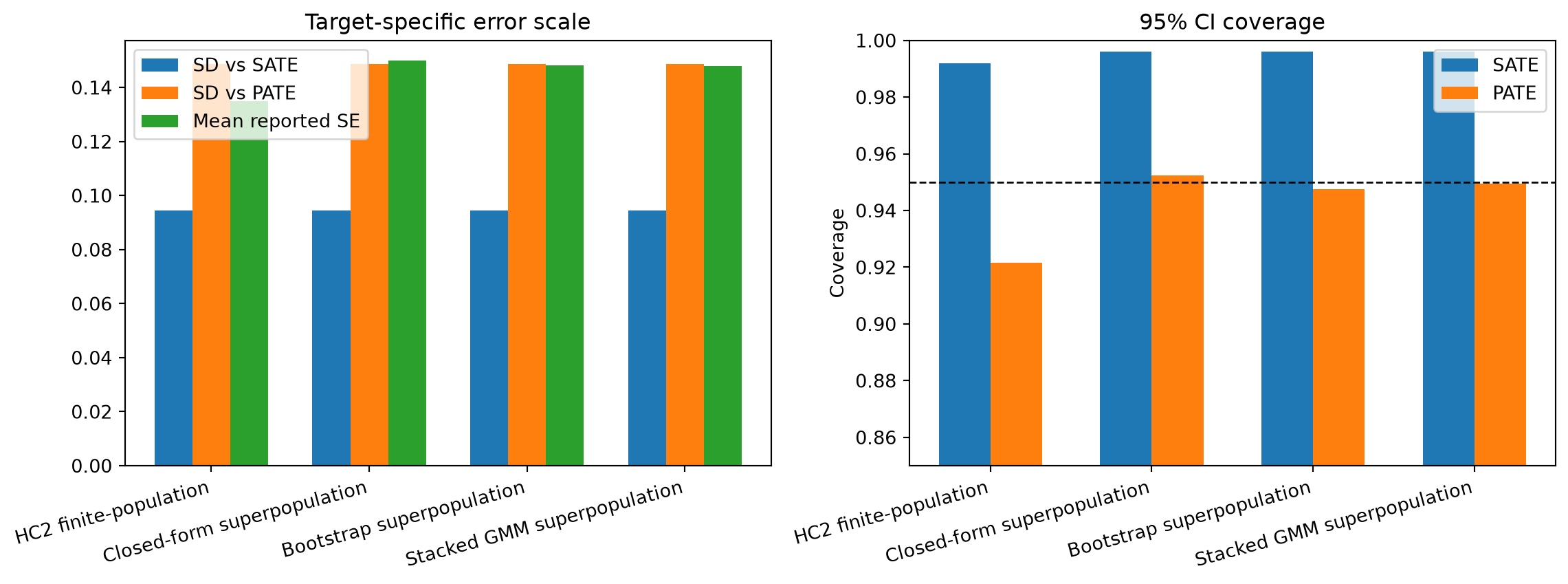
from html import escape

import matplotlib.pyplot as plt
import numpy as np
from IPython.display import HTML, display

import crabbymetrics as cm

np.set_printoptions(precision=4, suppress=True)


def html_table(headers, rows):
    parts = [
        "<table>",
        "<thead>",
        "<tr>",
        *[f"<th>{escape(str(header))}</th>" for header in headers],
        "</tr>",
        "</thead>",
        "<tbody>",
    ]
    for row in rows:
        parts.append("<tr>")
        for cell in row:
            parts.append(f"<td>{cell}</td>")
        parts.append("</tr>")
    parts.extend(["</tbody>", "</table>"])
    return "".join(parts)


def hc2_covariance(design, residuals):
    xtx_inv = np.linalg.inv(design.T @ design)
    leverage = np.sum(design * (design @ xtx_inv), axis=1)
    scale = residuals**2 / np.clip(1.0 - leverage, 1e-12, None)
    meat = design.T @ (design * scale[:, None])
    return xtx_inv @ meat @ xtx_inv


def bridging_gmm_moments(theta, data):
    x = data["x"]
    z = data["z"]
    y = data["y"]
    p = x.shape[1]

    mu = theta[:p]
    alpha = theta[p]
    tau = theta[p + 1]
    beta = theta[p + 2 : p + 2 + p]
    gamma = theta[p + 2 + p :]

    w = x - mu
    resid = y - alpha - tau * z - w @ beta - (w * z[:, None]) @ gamma
    l = np.column_stack([np.ones(x.shape[0]), z, w, w * z[:, None]])

    return np.column_stack(
        [
            x - mu,
            l * resid[:, None],
        ]
    )


def fit_tau_from_raw_rows(z, y, x):
    mu = x.mean(axis=0)
    w = x - mu
    interacted_design = np.column_stack([z, w, z[:, None] * w])
    model = cm.OLS()
    model.fit(interacted_design, y)
    return float(np.asarray(model.summary(vcov="hc1")["coef"])[0])


def raw_row_bootstrap_se(z, y, x, n_bootstrap, seed):
    rng = np.random.default_rng(seed)
    n = z.shape[0]
    tau_draws = np.empty(n_bootstrap)
    for draw in range(n_bootstrap):
        idx = rng.integers(0, n, size=n)
        tau_draws[draw] = fit_tau_from_raw_rows(z[idx], y[idx], x[idx])
    return float(tau_draws.std(ddof=1))


def fit_bridging_methods(z, y, x, n_bootstrap=300, bootstrap_seed=0):
    p = x.shape[1]
    mu = x.mean(axis=0)
    w = x - mu

    interacted_design = np.column_stack([z, w, z[:, None] * w])
    ols = cm.OLS()
    ols.fit(interacted_design, y)
    ols_summary = ols.summary(vcov="hc1")

    coef = np.asarray(ols_summary["coef"])
    params = np.concatenate([[ols_summary["intercept"]], coef])
    full_design = np.column_stack([np.ones(z.shape[0]), interacted_design])
    residuals = y - full_design @ params

    hc2_vcov = hc2_covariance(full_design, residuals)
    tau_hat = float(coef[0])
    se_hc2 = float(np.sqrt(hc2_vcov[1, 1]))

    gamma_hat = coef[-p:]
    superpop_correction = float(gamma_hat @ np.cov(w.T) @ gamma_hat / z.shape[0])
    se_closed_form = float(np.sqrt(hc2_vcov[1, 1] + superpop_correction))
    se_bootstrap = raw_row_bootstrap_se(z, y, x, n_bootstrap=n_bootstrap, seed=bootstrap_seed)

    theta0 = np.concatenate([mu, [params[0], tau_hat], coef[1:]])
    gmm = cm.GMM(
        bridging_gmm_moments,
        max_iterations=200,
        tolerance=1e-8,
        fd_eps=1e-5,
    )
    gmm.fit({"x": x, "z": z, "y": y}, theta0, weighting="identity")
    gmm_summary = gmm.summary(vcov="sandwich", omega="iid")

    tau_index = p + 1
    tau_gmm = float(np.asarray(gmm_summary["coef"])[tau_index])
    se_gmm = float(np.asarray(gmm_summary["se"])[tau_index])

    return {
        "tau_ols": tau_hat,
        "se_hc2": se_hc2,
        "se_closed_form": se_closed_form,
        "se_bootstrap": se_bootstrap,
        "tau_gmm": tau_gmm,
        "se_gmm": se_gmm,
    }


def simulate_bridging(reps, n, seed, n_bootstrap):
    tau_hc2 = []
    tau_closed = []
    tau_bootstrap = []
    tau_gmm = []
    se_hc2 = []
    se_closed = []
    se_bootstrap = []
    se_gmm = []
    sate_targets = []

    for rep in range(reps):
        rng = np.random.default_rng(seed + rep)
        x = rng.normal(size=(n, 2))
        y0 = x[:, 0] + x[:, 0] ** 2 + rng.uniform(-0.5, 0.5, n)
        y1 = x[:, 1] + x[:, 1] ** 2 + rng.uniform(-1.0, 1.0, n)
        z = rng.binomial(1, 0.6, n).astype(float)
        y = y0 * (1.0 - z) + y1 * z

        fit = fit_bridging_methods(z, y, x, n_bootstrap=n_bootstrap, bootstrap_seed=rep)
        tau_hc2.append(fit["tau_ols"])
        tau_closed.append(fit["tau_ols"])
        tau_bootstrap.append(fit["tau_ols"])
        tau_gmm.append(fit["tau_gmm"])
        se_hc2.append(fit["se_hc2"])
        se_closed.append(fit["se_closed_form"])
        se_bootstrap.append(fit["se_bootstrap"])
        se_gmm.append(fit["se_gmm"])
        sate_targets.append(float(np.mean(y1 - y0)))

    def summarize(estimates, ses):
        estimates = np.asarray(estimates)
        ses = np.asarray(ses)
        sate_targets_arr = np.asarray(sate_targets)
        sate_errors = estimates - sate_targets_arr
        pate_errors = estimates
        return {
            "mean_estimate": float(estimates.mean()),
            "sate_error_sd": float(sate_errors.std(ddof=1)),
            "pate_error_sd": float(pate_errors.std(ddof=1)),
            "mean_se": float(ses.mean()),
            "coverage_sate": float((np.abs(sate_errors) <= 1.96 * ses).mean()),
            "coverage_pate": float((np.abs(pate_errors) <= 1.96 * ses).mean()),
        }

    return [
        {"method": "HC2 finite-population", **summarize(tau_hc2, se_hc2)},
        {"method": "Closed-form superpopulation", **summarize(tau_closed, se_closed)},
        {"method": "Bootstrap superpopulation", **summarize(tau_bootstrap, se_bootstrap)},
        {"method": "Stacked GMM superpopulation", **summarize(tau_gmm, se_gmm)},
    ]