Show code
import itertools
import math

import matplotlib.pyplot as plt
import numpy as np
import pandas as pd

import crabbymetrics as cm

np.set_printoptions(precision=4, suppress=True)Completely randomized experiments and the Fisher randomization test
Chapter 3 is the cleanest design-based chapter in the book. With fixed potential outcomes and a known treatment-assignment mechanism, Fisherian inference is just a permutation problem.
import itertools
import math
import matplotlib.pyplot as plt
import numpy as np
import pandas as pd
import crabbymetrics as cm
np.set_printoptions(precision=4, suppress=True)rng = np.random.default_rng(3)
n = 12
n1 = 6
y0 = np.array([3.0, 3.3, 2.8, 4.0, 3.5, 2.9, 4.2, 3.1, 2.7, 3.8, 3.4, 4.1])
tau = 1.2 + 0.3 * np.linspace(-1.0, 1.0, n)
y1 = y0 + tau
z_obs = np.array([1, 1, 1, 0, 0, 1, 0, 0, 1, 0, 1, 0], dtype=float)
y_obs = z_obs * y1 + (1.0 - z_obs) * y0
def diff_in_means(y, z):
treated = z == 1.0
control = ~treated
return y[treated].mean() - y[control].mean()
def normal_pvalue(z_stat):
return math.erfc(abs(float(z_stat)) / math.sqrt(2.0))
tau_hat = diff_in_means(y_obs, z_obs)
model = cm.OLS()
model.fit(z_obs[:, None], y_obs)
asy = model.summary(vcov="hc1")
z_stat = asy["coef"][0] / asy["coef_se"][0]
assignments = np.array(list(itertools.combinations(range(n), n1)))
sharp_null_draws = np.zeros(assignments.shape[0])
for idx, treated_ids in enumerate(assignments):
z = np.zeros(n)
z[list(treated_ids)] = 1.0
sharp_null_draws[idx] = diff_in_means(y_obs, z)
frt_pvalue = np.mean(np.abs(sharp_null_draws) >= abs(tau_hat))
pd.DataFrame(
{
"estimate": [tau_hat],
"HC1 normal p-value": [normal_pvalue(z_stat)],
"Fisher randomization p-value": [frt_pvalue],
}
)| estimate | HC1 normal p-value | Fisher randomization p-value | |
|---|---|---|---|
| 0 | 0.369697 | 0.105021 | 0.149351 |
fig, ax = plt.subplots(figsize=(6, 4))
ax.hist(sharp_null_draws, bins=30, color="tab:blue", alpha=0.75)
ax.axvline(tau_hat, color="black", linestyle="--", linewidth=2.0)
ax.set_xlabel("Difference in means under sharp null")
ax.set_ylabel("Count")
ax.set_title("Exact Fisher randomization distribution")
fig.tight_layout()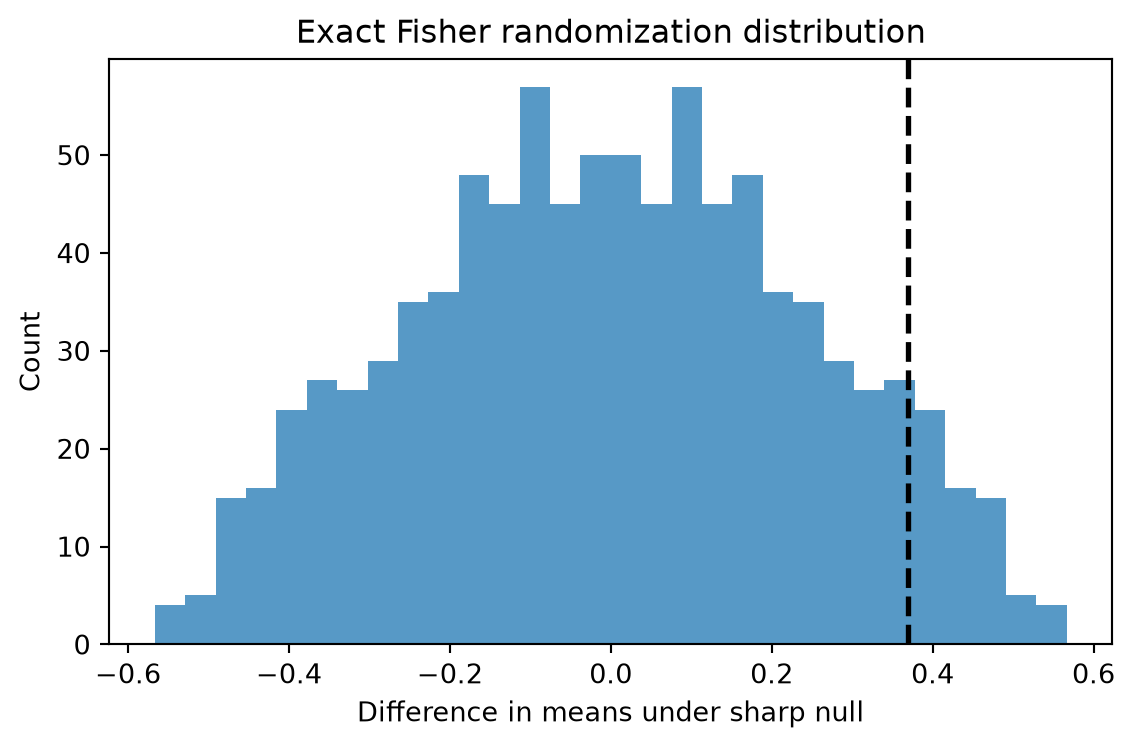
The randomization distribution above does not need any sampling model for the outcomes. The only ingredients are:
That is why Chapter 3 sits so naturally in plain numpy: the inferential object is the assignment rule, not a parametric likelihood.
For a completely randomized experiment, crabbymetrics.OLS can report the same difference in means that the experiment was built around, but the Fisher test itself is a permutation calculation. That design-first perspective is the point of the chapter.