import matplotlib.pyplot as plt
import numpy as np

from crabbymetrics import SyntheticControl

np.set_printoptions(precision=4, suppress=True)Synthetic Control Example
This example builds a 50-unit, 20-period panel from a two-factor model. The treated unit is selected from the high end of the first principal component of the pre-treatment panel, so the raw donor average has obvious pre-trend mismatch. SyntheticControl reweights donors on the simplex to match the treated unit before treatment at period 15.
1 Generate A Factor-Model Panel
rng = np.random.default_rng(2027)

n_units = 50
n_periods = 20
treatment_start = 15

time = np.arange(n_periods)

# Two latent time factors with different dynamics.
factors = np.column_stack(
    [
        np.linspace(-1.5, 1.8, n_periods),
        np.sin(np.linspace(0, 3 * np.pi, n_periods)),
    ]
)

# Unit-specific loadings and mild unit trends.
loadings = rng.normal(size=(n_units, 2))
unit_intercepts = rng.normal(scale=0.4, size=n_units)
unit_trends = rng.normal(scale=0.03, size=n_units)

noise = rng.normal(scale=0.12, size=(n_units, n_periods))
untreated_panel = (
    unit_intercepts[:, None]
    + unit_trends[:, None] * time
    + loadings @ factors.T
    + noise
)

pre_panel = untreated_panel[:, : treatment_start - 1]
pre_centered = pre_panel - pre_panel.mean(axis=1, keepdims=True)
_, _, vt = np.linalg.svd(pre_centered, full_matrices=False)
pc1_scores = pre_centered @ vt[0]

# Select the treated unit from the large-positive tail of PC1.
treated_unit = int(np.argmax(pc1_scores))
donor_idx = np.array([idx for idx in range(n_units) if idx != treated_unit])

treated_untreated = untreated_panel[treated_unit]
donor_panel = untreated_panel[donor_idx].T
equal_weight_path = donor_panel.mean(axis=1)

# Treatment turns on after period 14 (1-indexed treatment at period 15).
treatment_effect = np.where(
    time >= treatment_start - 1,
    0.8 + 0.18 * (time - (treatment_start - 1)),
    0.0,
)
treated_observed = treated_untreated + treatment_effect

print("treated unit:", treated_unit)
print("treatment begins at period:", treatment_start)
print("treated unit PC1 score:", round(float(pc1_scores[treated_unit]), 4))
treated unit: 11
treatment begins at period: 15
treated unit PC1 score: 8.73762 Fit Synthetic Control On Pre-Treatment Periods
pre_idx = slice(0, treatment_start - 1)
post_idx = slice(treatment_start - 1, None)

model = SyntheticControl(max_iterations=500)
model.fit(donor_panel[pre_idx], treated_observed[pre_idx])
summary = model.summary()

synth_path = model.predict(donor_panel)
pre_rmse_equal = np.sqrt(np.mean((treated_observed[pre_idx] - equal_weight_path[pre_idx]) ** 2))
pre_rmse_synth = float(summary["pre_rmse"])

weights = np.asarray(summary["weights"])
top_weight_idx = np.argsort(weights)[-5:][::-1]

print("equal-weight pre RMSE:", round(float(pre_rmse_equal), 4))
print("synthetic-control pre RMSE:", round(pre_rmse_synth, 4))
print("top donor weights:")
for rank, idx in enumerate(top_weight_idx, start=1):
    print(
        f"  {rank}. donor unit {int(donor_idx[idx])}: weight={weights[idx]:.4f}"
    )
equal-weight pre RMSE: 2.6003
synthetic-control pre RMSE: 0.6732
top donor weights:
1. donor unit 17: weight=1.0000
2. donor unit 49: weight=0.0000
3. donor unit 24: weight=0.0000
4. donor unit 22: weight=0.0000
5. donor unit 21: weight=0.00003 Compare Raw Trends To Synthetic Control
fig, axes = plt.subplots(1, 2, figsize=(12, 4.8), constrained_layout=True)

axes[0].plot(time + 1, treated_observed, color="black", lw=2.2, label="Treated")
axes[0].plot(time + 1, equal_weight_path, color="#d95f02", lw=1.8, label="Equal-weight donors")
axes[0].plot(time + 1, synth_path, color="#1b9e77", lw=2.0, label="Synthetic control")
axes[0].axvline(treatment_start, color="0.4", ls="--", lw=1)
axes[0].set_title("Levels")
axes[0].set_xlabel("Period")
axes[0].set_ylabel("Outcome")
axes[0].legend(frameon=False)

axes[1].plot(
    time + 1,
    treated_observed - equal_weight_path,
    color="#d95f02",
    lw=1.8,
    label="Treated - equal-weight donors",
)
axes[1].plot(
    time + 1,
    treated_observed - synth_path,
    color="#1b9e77",
    lw=2.0,
    label="Treated - synthetic control",
)
axes[1].axhline(0.0, color="0.5", lw=1)
axes[1].axvline(treatment_start, color="0.4", ls="--", lw=1)
axes[1].set_title("Gap")
axes[1].set_xlabel("Period")
axes[1].set_ylabel("Difference")
axes[1].legend(frameon=False)

plt.show()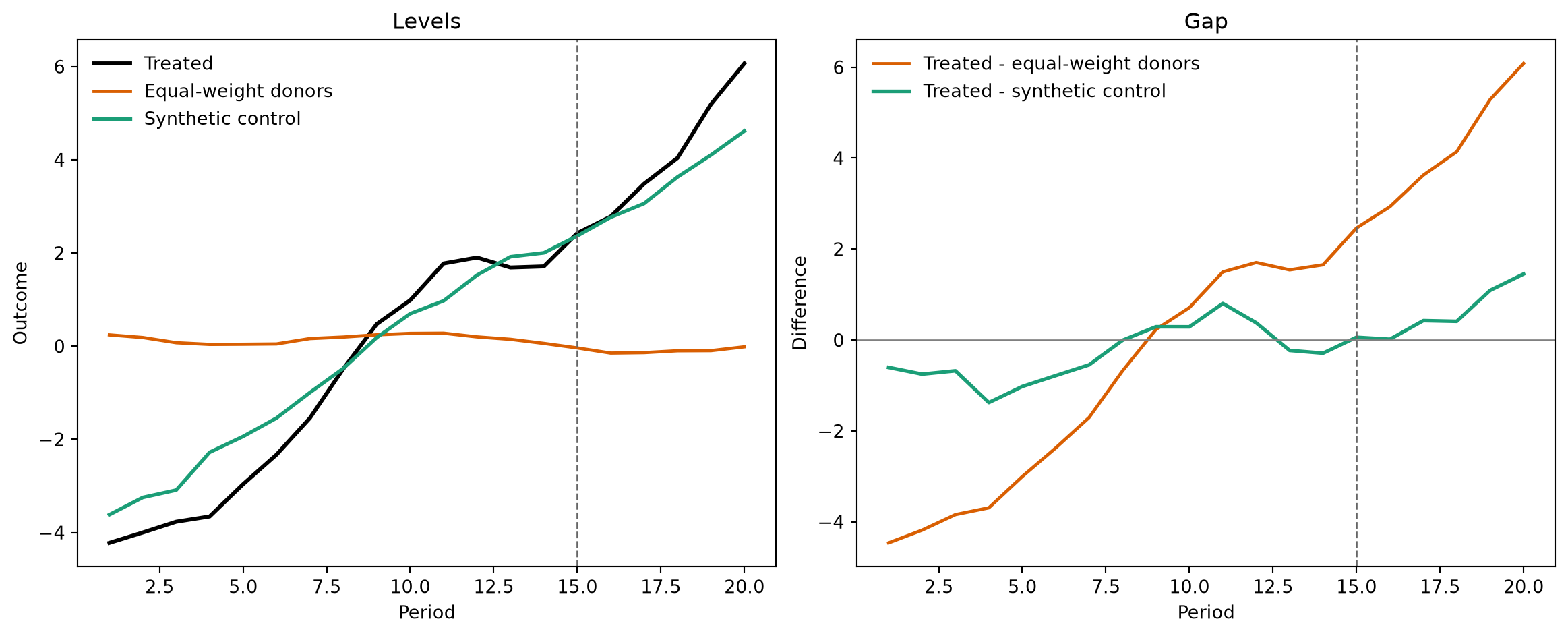
The treated unit was deliberately chosen from the high-positive side of the first principal component, so the naive donor average fails even before treatment. The synthetic control fit sharply reduces pre-treatment mismatch, making the post-treatment gap much easier to interpret as treatment effect rather than latent-factor imbalance.
4 Optimization diagnostics
The solver minimizes half the mean squared pre-treatment error directly on the nonnegative unit simplex. An active-set quadratic solver permits exact zero donor weights; a softmax parameterization can falsely flatten gradients near a boundary. The internally normalized donor-minus-target design avoids large-common-level cancellation. summary() reports objective in original outcome-squared units, iterations, feasibility_error, scaled_kkt_residual, stop_reason, and converged. The KKT residual uses the normalized design and is not in raw outcome units. Insufficient iterations or a failed optimality check raises ValueError and clears fitted state. Prediction rejects nonfinite donor inputs.
print({key: summary[key] for key in
       ['solver', 'iterations', 'objective', 'scaled_kkt_residual',
        'feasibility_error', 'stop_reason', 'converged']})
{'solver': 'active_set_simplex_qp', 'iterations': 52, 'objective': 0.22661881128084935, 'scaled_kkt_residual': 0.0, 'feasibility_error': 0.0, 'stop_reason': 'kkt_optimality', 'converged': True}The Proposition 99 regression fixture reproduces outcome-only SCM pre-RMSE 1.656400 and ATT -19.513630 from R and an independent constrained solver. It is not the canonical predictor-weighted SCM specification.