import matplotlib.pyplot as plt
import numpy as np

from crabbymetrics import KernelBasis, OLS, Ridge

np.set_printoptions(precision=4, suppress=True)Ridge Example
This page focuses on the closed-form Ridge estimator. Scalar penalties use an augmented QR least-squares system. Penalty grids reuse a centered, weighted SVD within each CV fold and the full-data path; zero penalties retain the QR path. CV still uses deterministic row-modulo folds. Weights are validated before splitting, zero-weight rows do not count toward inference, and failed refits clear fitted state.
1 Imports
2 A Misspecified 20-Feature Regression Problem
The next setup deliberately makes plain linear regression work a bit too hard:
- there are
k = 20observed regressors - the design is correlated through a lower-dimensional latent factor structure
- the true response includes interactions, a sine term, and an exponential term
- we still fit ordinary linear models on the raw regressors
That is a useful place to look at ridge. The model is misspecified, so shrinking noisy linear directions can improve held-out prediction error even though the regression function is not actually linear.
rng = np.random.default_rng(20260322)

n_train = 1000
n_test = 500
k = 20
latent_dim = 6
penalties = np.logspace(-4, 3, 50)

loadings = rng.normal(scale=0.8, size=(latent_dim, k))


def sample_x(n):
    latent = rng.normal(size=(n, latent_dim))
    return latent @ loadings + 0.35 * rng.normal(size=(n, k))


def signal_fn(x):
    return (
        1.4 * x[:, 0]
        - 1.1 * x[:, 1]
        + 0.8 * x[:, 2] * x[:, 3]
        - 0.6 * x[:, 4] * x[:, 5]
        + 1.5 * np.exp(0.25 * x[:, 6])
        + 0.9 * np.sin(x[:, 7])
        - 0.7 * np.cos(0.5 * x[:, 8] * x[:, 9])
    )


x_train_raw = sample_x(n_train)
x_test_raw = sample_x(n_test)

y_train = signal_fn(x_train_raw) + rng.normal(scale=1.0, size=n_train)
y_test = signal_fn(x_test_raw) + rng.normal(scale=1.0, size=n_test)

train_mean = x_train_raw.mean(axis=0)
train_std = x_train_raw.std(axis=0)
train_std[train_std == 0.0] = 1.0

x_train = (x_train_raw - train_mean) / train_std
x_test = (x_test_raw - train_mean) / train_std

ols = OLS()
ols.fit(x_train, y_train)
mse_ols = float(np.mean((y_test - ols.predict(x_test)) ** 2))

ridge = Ridge(penalty=penalties, cv=5)
ridge.fit(x_train, y_train)
ridge_summary = ridge.summary(vcov="vanilla")
hac_summary = ridge.summary(vcov="newey_west", lags=4)
mse_ridge = float(np.mean((y_test - ridge.predict(x_test)) ** 2))

print("penalty grid head:", penalties[:6])
print("selected ridge penalty:", ridge.best_penalty)
print("OLS test MSE:", round(mse_ols, 4))
print("Ridge test MSE:", round(mse_ridge, 4))
print("selected-penalty HAC SE head:", np.round(hac_summary["coef_se"][:5], 4))
penalty grid head: [0.0001 0.0001 0.0002 0.0003 0.0004 0.0005]
selected ridge penalty: 5.1794746792312125
OLS test MSE: 15.8738
Ridge test MSE: 15.7818
selected-penalty HAC SE head: [0.6352 0.3739 0.5067 0.4925 0.5212]3 Linear Ridge: CV Error Curve And Coefficient Paths
The first plot shows the deterministic 5-fold CV error across the full 50-point log-spaced penalty grid. The second shows the full coefficient path, one curve per regressor.
cv_mse = np.asarray(ridge_summary["cv_mse"])
coef_path = np.asarray(ridge_summary["coef_path"])

fig, axes = plt.subplots(1, 2, figsize=(14, 5.2), constrained_layout=True)

axes[0].plot(penalties, cv_mse, color="tab:blue", lw=2.0)
axes[0].axvline(ridge.best_penalty, color="black", linestyle="--", lw=1.5)
axes[0].set_xscale("log")
axes[0].set_title("5-fold CV error curve")
axes[0].set_xlabel("penalty")
axes[0].set_ylabel("mean squared error")

for j in range(k):
    axes[1].plot(penalties, coef_path[j], lw=1.1, alpha=0.8)
axes[1].axvline(ridge.best_penalty, color="black", linestyle="--", lw=1.5)
axes[1].set_xscale("log")
axes[1].set_title("Coefficient paths")
axes[1].set_xlabel("penalty")
axes[1].set_ylabel("coefficient value")

plt.show()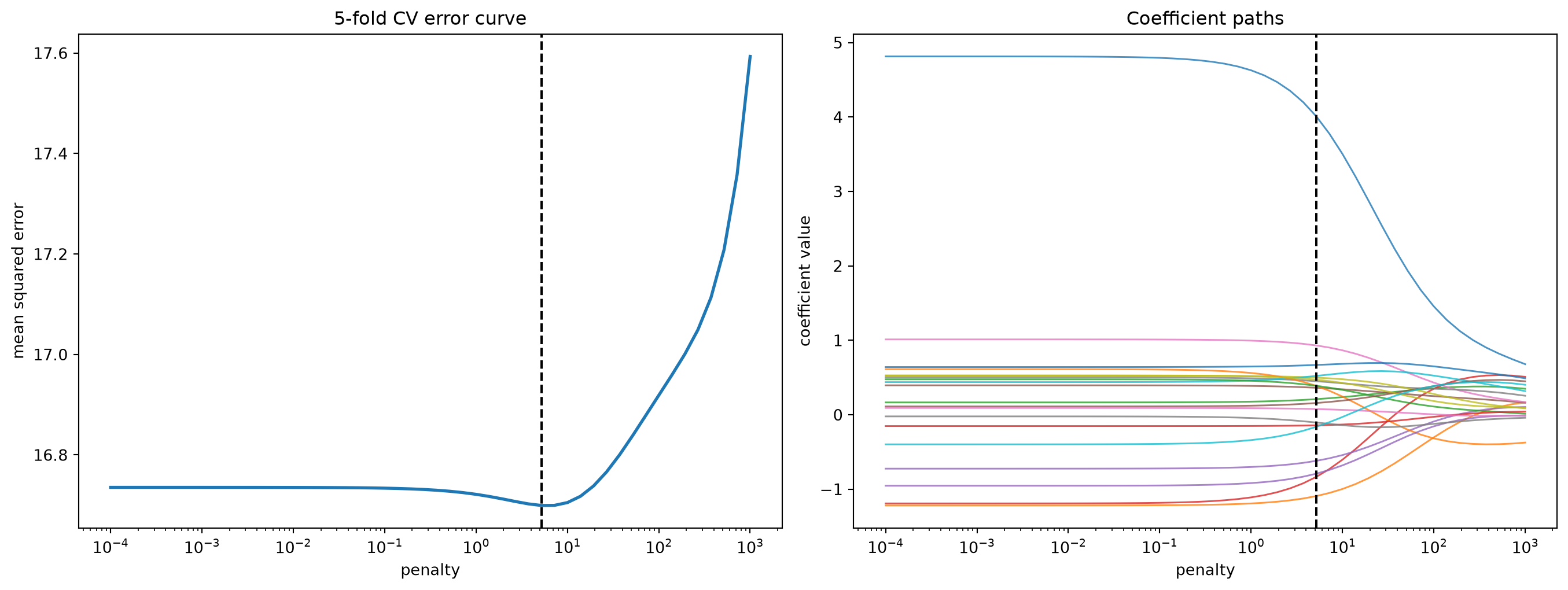
On this problem the linear ridge fit improves held-out MSE relative to OLS by shrinking unstable directions that are trying to stand in for omitted nonlinear structure.
4 Kernel Ridge On The Same Data
The same data still contain real nonlinear signal, so a richer basis should help. KernelBasis("gaussian") lifts the standardized regressors into a Gaussian similarity basis, and Ridge then solves the L2-regularized linear problem in that basis.
At this larger sample size, using all 1000 training points as kernel anchors would make the notebook unnecessarily heavy. So the next section uses a 300-point Gaussian anchor basis drawn from the training sample. That still demonstrates the nonlinear lift cleanly while keeping the page practical to cache.
anchor_idx = np.sort(rng.choice(n_train, size=300, replace=False))
x_kernel_basis = x_train[anchor_idx]

kernel = KernelBasis("gaussian", bandwidth=20.0)
kernel.fit(x_kernel_basis)
x_kernel_train = kernel.transform(x_train)
x_kernel_test = kernel.transform(x_test)

kernel_test_mse = np.zeros_like(penalties)
for i, penalty in enumerate(penalties):
    kernel_ridge = Ridge(penalty=float(penalty))
    kernel_ridge.fit(x_kernel_train, y_train)
    kernel_test_mse[i] = np.mean((y_test - kernel_ridge.predict(x_kernel_test)) ** 2)

best_kernel_idx = int(np.argmin(kernel_test_mse))
best_kernel_penalty = float(penalties[best_kernel_idx])
mse_kernel_ridge = float(kernel_test_mse[best_kernel_idx])

print("kernel-ridge best penalty on held-out curve:", best_kernel_penalty)
print("kernel anchor count:", x_kernel_basis.shape[0])
print("kernel-ridge feature dimension:", x_kernel_train.shape[1])
print("OLS test MSE:", round(mse_ols, 4))
print("linear ridge test MSE:", round(mse_ridge, 4))
print("kernel ridge test MSE:", round(mse_kernel_ridge, 4))
kernel-ridge best penalty on held-out curve: 0.0013894954943731374
kernel anchor count: 300
kernel-ridge feature dimension: 300
OLS test MSE: 15.8738
linear ridge test MSE: 15.7818
kernel ridge test MSE: 3.31fig, ax = plt.subplots(figsize=(7.2, 5.0), constrained_layout=True)
ax.plot(penalties, kernel_test_mse, color="tab:green", lw=2.0)
ax.axvline(best_kernel_penalty, color="black", linestyle="--", lw=1.5)
ax.set_xscale("log")
ax.set_title("Kernel ridge held-out MSE curve")
ax.set_xlabel("penalty")
ax.set_ylabel("mean squared error")
plt.show()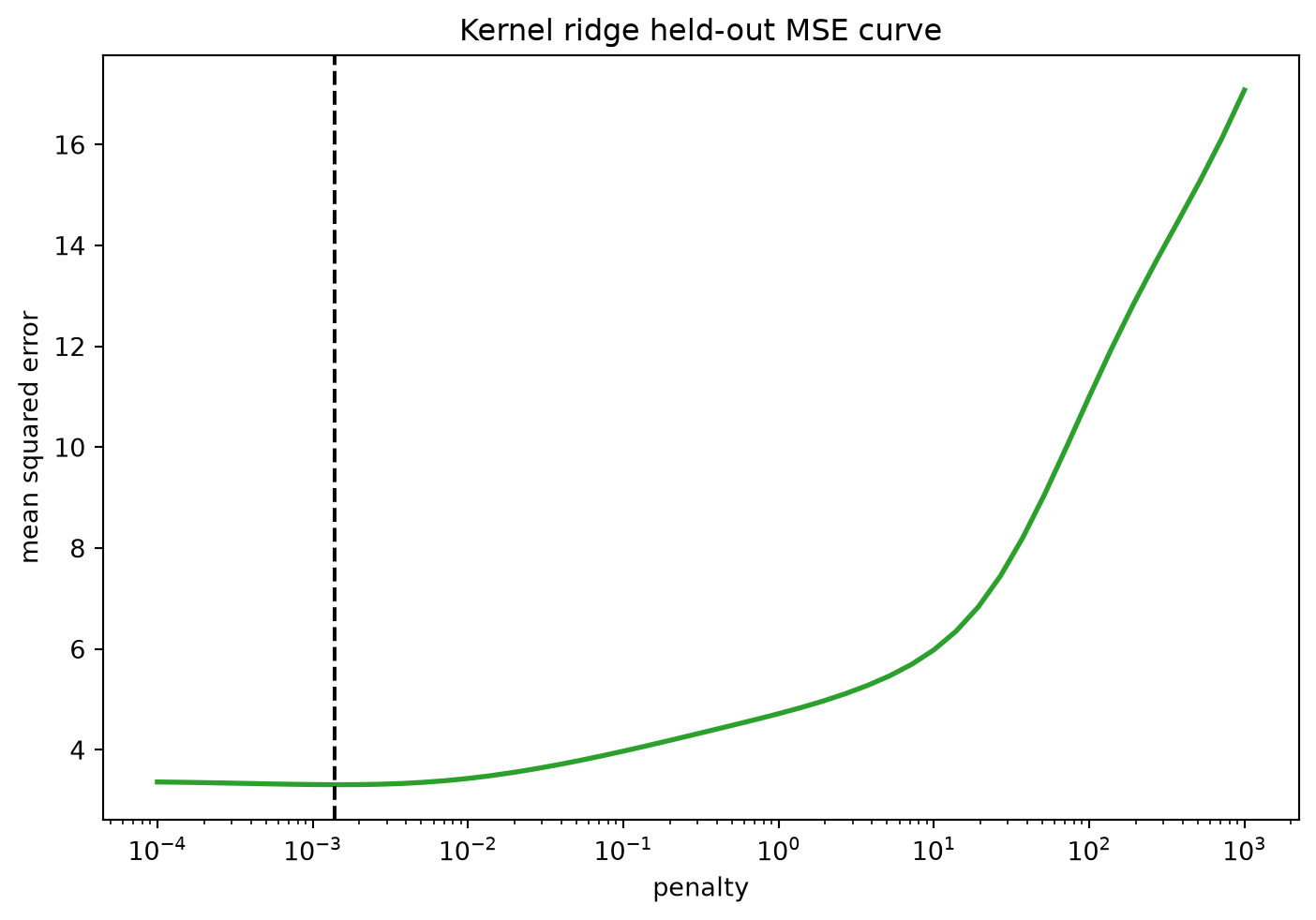
On this draw the Gaussian kernel basis recovers substantially more of the interaction and smooth nonlinear structure than the raw linear design, so the kernel-ridge fit delivers the best out-of-sample MSE of the three.