import matplotlib.pyplot as plt
import numpy as np

from crabbymetrics import (
    Logit,
    Optimizers,
)

np.set_printoptions(precision=4, suppress=True)Optimizers
This page shows the direct optimizer wrappers in the style they are meant to be used: a Python callback for the objective, a starting value, optional derivative callbacks, and a plain dictionary back with the minimizer and objective value. The first section rebuilds a Bernoulli logit fit from its likelihood, then the page moves to two rougher test functions where nonlinear conjugate gradient and simulated annealing are more natural tools.
1 Imports
2 BFGS On A Bernoulli Logit Likelihood
The built-in Logit class reports the linear index and probability for label 1. The synthetic data below are therefore generated from
Pr(y = 1 | x) = sigmoid(theta_0 + x @ theta).
We then minimize the negative Bernoulli log-likelihood directly with Optimizers.minimize_bfgs and compare the optimizer output with the built-in regression.
rng = np.random.default_rng(7)
n = 1200
k = 3

theta_true = np.array([0.35, -0.95, 0.9, -0.4])
x = rng.normal(size=(n, k))
X = np.column_stack([np.ones(n), x])

def sigmoid(z):
    return 1.0 / (1.0 + np.exp(-z))

prob_one = sigmoid(X @ theta_true)
y = rng.binomial(1, prob_one).astype(np.int32)

def bernoulli_nll(theta):
    eta = X @ theta
    return float(np.sum(np.logaddexp(0.0, eta) - y * eta))

def bernoulli_grad(theta):
    eta = X @ theta
    return X.T @ (sigmoid(eta) - y)

bfgs_result = Optimizers.minimize_bfgs(
    bernoulli_nll,
    np.zeros(k + 1),
    bernoulli_grad,
    max_iterations=300,
)

logit = Logit(alpha=0.0, max_iterations=300)
logit.fit(x, y)
logit_summary = logit.summary()
logit_theta = np.concatenate(
    [[logit_summary["intercept"]], np.asarray(logit_summary["coef"])]
)

print("true theta:", theta_true)
print("BFGS theta:", bfgs_result["x"])
print("Logit theta:", logit_theta)
print("max |BFGS - Logit|:", round(float(np.max(np.abs(bfgs_result["x"] - logit_theta))), 8))
print("BFGS objective:", round(float(bfgs_result["fun"]), 6))
true theta: [ 0.35 -0.95 0.9 -0.4 ]
BFGS theta: [ 0.2692 -1.1055 0.9564 -0.3718]
Logit theta: [ 0.2692 -1.1055 0.9564 -0.3718]
max |BFGS - Logit|: 7.73e-06
BFGS objective: 630.913716prob_one_bfgs = sigmoid(X @ bfgs_result["x"])
prob_one_logit = sigmoid(X @ logit_theta)
labels = ["intercept", "x1", "x2", "x3"]
positions = np.arange(len(labels))
width = 0.25
fig, axes = plt.subplots(1, 2, figsize=(12.5, 4.8), constrained_layout=True)
axes[0].bar(positions - width, theta_true, width=width, label="true")
axes[0].bar(positions, bfgs_result["x"], width=width, label="BFGS")
axes[0].bar(positions + width, logit_theta, width=width, label="Logit")
axes[0].set_xticks(positions)
axes[0].set_xticklabels(labels)
axes[0].set_title("Same Bernoulli likelihood, same coefficients")
axes[0].set_ylabel("coefficient")
axes[0].legend()
axes[1].scatter(prob_one_bfgs, prob_one_logit, s=12, alpha=0.55)
axes[1].plot([0, 1], [0, 1], color="black", linewidth=1.0)
axes[1].set_title("Class-1 fitted probabilities")
axes[1].set_xlabel("BFGS")
axes[1].set_ylabel("Logit")
plt.show()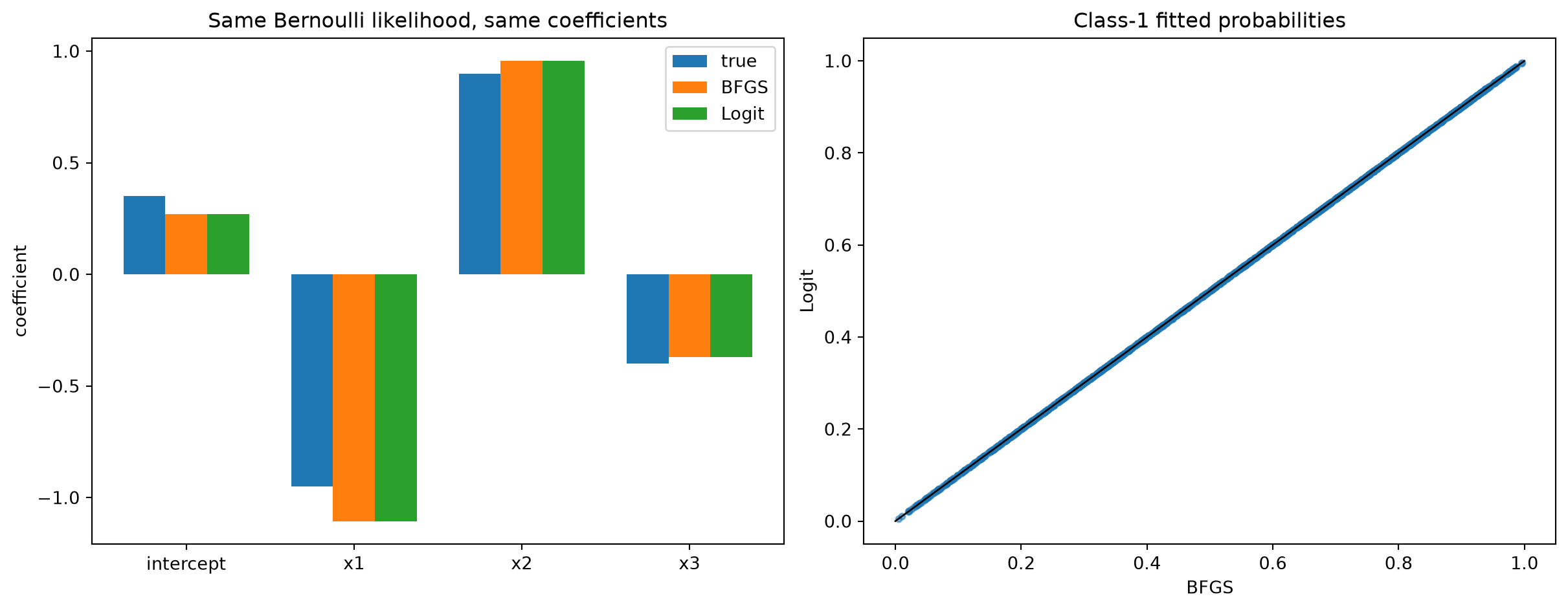
This is the simplest pattern for custom M-estimation in the package today: write the objective and gradient, run a direct optimizer, and treat the returned x as the estimate. For smooth likelihoods, BFGS is a strong default.
3 Nonlinear Conjugate Gradient On Beale’s Function
The Beale function is a good stress test for deterministic gradient-based methods. It is smooth, but the surface bends sharply and the minimum sits in a narrow basin at (3, 0.5).
def beale(theta):
    x1, x2 = theta
    return float(
        (1.5 - x1 + x1 * x2) ** 2
        + (2.25 - x1 + x1 * x2**2) ** 2
        + (2.625 - x1 + x1 * x2**3) ** 2
    )

def beale_grad(theta):
    x1, x2 = theta
    a = 1.5 - x1 + x1 * x2
    b = 2.25 - x1 + x1 * x2**2
    c = 2.625 - x1 + x1 * x2**3
    dfdx1 = 2 * a * (-1 + x2) + 2 * b * (-1 + x2**2) + 2 * c * (-1 + x2**3)
    dfdx2 = 2 * a * x1 + 4 * b * x1 * x2 + 6 * c * x1 * x2**2
    return np.array([dfdx1, dfdx2])

cg_start = np.array([1.0, 1.0])
cg_result = Optimizers.minimize_nonlinear_cg(
    beale,
    cg_start,
    beale_grad,
    max_iterations=2000,
    restart_iters=20,
    tolerance=1e-6,
)

print(cg_result)
{'x': array([3. , 0.5]), 'fun': 2.422589769173851e-24, 'nit': 2000, 'success': True, 'message': 'Gradient norm below tolerance (2.608e-12 <= 1.000e-6)', 'method': 'nonlinear_cg'}x1 = np.linspace(-1.0, 4.5, 320)
x2 = np.linspace(-0.5, 1.5, 280)
xx1, xx2 = np.meshgrid(x1, x2)
zz = (
(1.5 - xx1 + xx1 * xx2) ** 2
+ (2.25 - xx1 + xx1 * xx2**2) ** 2
+ (2.625 - xx1 + xx1 * xx2**3) ** 2
)
fig, ax = plt.subplots(figsize=(7.4, 5.4), constrained_layout=True)
contours = ax.contourf(xx1, xx2, np.log1p(zz), levels=40, cmap="cividis")
ax.scatter(cg_start[0], cg_start[1], s=70, color="white", edgecolor="black", label="start")
ax.scatter(
cg_result["x"][0],
cg_result["x"][1],
s=90,
color="#e4572e",
edgecolor="black",
label="nonlinear CG solution",
)
ax.scatter(3.0, 0.5, s=70, color="#4c956c", edgecolor="black", label="global minimum")
ax.set_title("Beale function")
ax.set_xlabel("x1")
ax.set_ylabel("x2")
ax.legend(loc="upper left")
fig.colorbar(contours, ax=ax, label="log(1 + f(x))")
plt.show()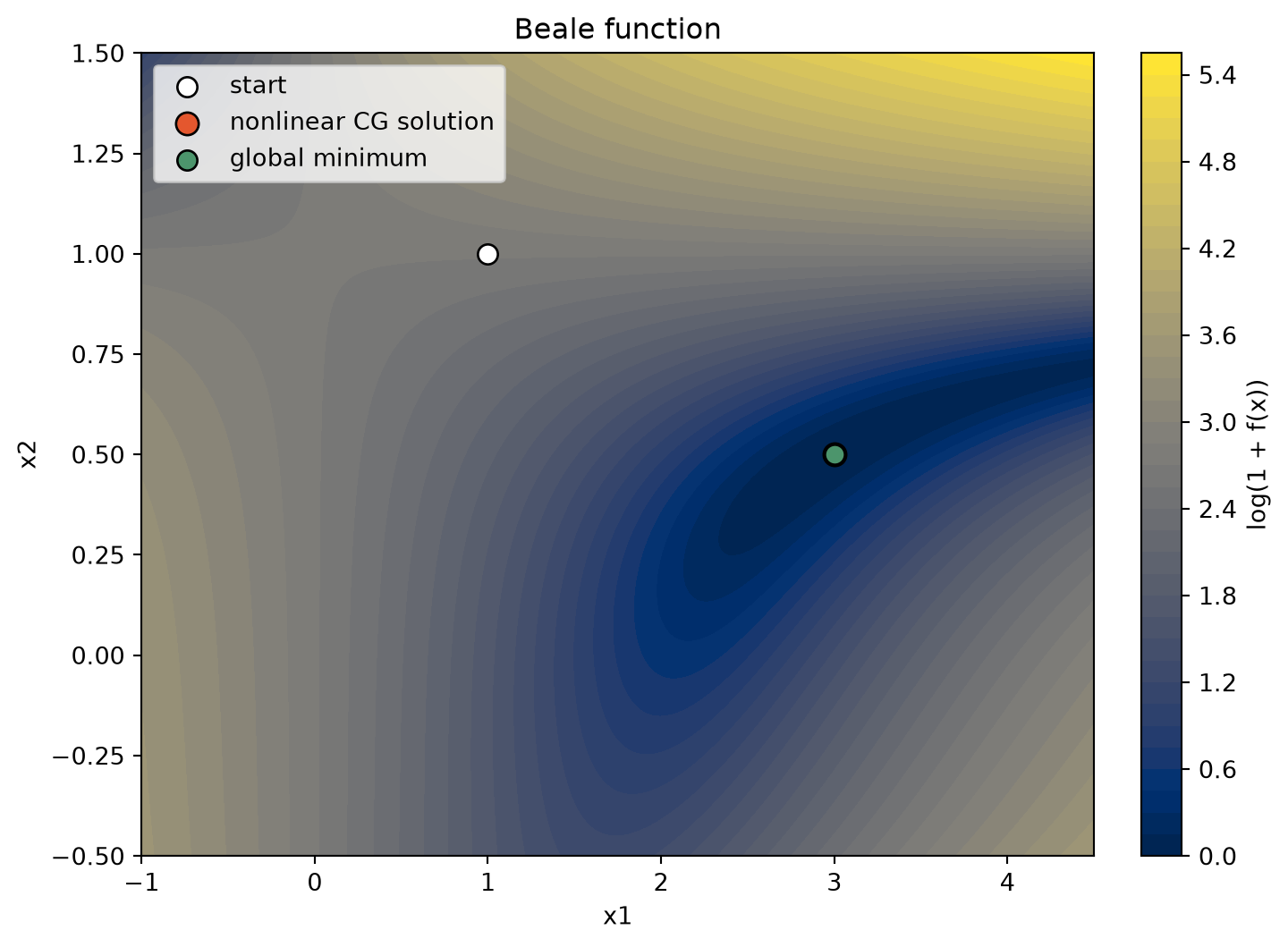
This is still a local optimizer. It works well here because the problem is smooth and we supplied the exact gradient, but the surface is already irregular enough that a cheap first-order method would spend much longer wandering around the valley.
4 Simulated Annealing On Rastrigin’s Function
Rastrigin’s function is the opposite kind of problem: a simple global minimum at the origin, but with a dense field of local minima. That is the setting where a stochastic global method is much more natural than a deterministic descent method.
def rastrigin(theta):
    a = 10.0
    return float(a * theta.size + np.sum(theta**2 - a * np.cos(2.0 * np.pi * theta)))

sa_start = np.array([4.0, -3.5])
sa_result = Optimizers.minimize_simulated_annealing(
    rastrigin,
    sa_start,
    lower=np.array([-5.12, -5.12]),
    upper=np.array([5.12, 5.12]),
    temp=12.0,
    step_size=0.6,
    max_iterations=8000,
    seed=123,
)

print(sa_result)
{'x': array([ 0.0007, -0.0022]), 'fun': 0.001062433017398945, 'nit': 2078, 'success': False, 'message': 'BestStallIterExceeded', 'method': 'simulated_annealing'}x1 = np.linspace(-5.12, 5.12, 320)
x2 = np.linspace(-5.12, 5.12, 320)
xx1, xx2 = np.meshgrid(x1, x2)
zz = 20.0 + (xx1**2 - 10.0 * np.cos(2.0 * np.pi * xx1)) + (
xx2**2 - 10.0 * np.cos(2.0 * np.pi * xx2)
)
fig, ax = plt.subplots(figsize=(7.4, 5.6), constrained_layout=True)
contours = ax.contourf(xx1, xx2, zz, levels=70, cmap="magma")
ax.scatter(sa_start[0], sa_start[1], s=75, color="white", edgecolor="black", label="start")
ax.scatter(
sa_result["x"][0],
sa_result["x"][1],
s=95,
color="#7bd389",
edgecolor="black",
label="annealed solution",
)
ax.scatter(0.0, 0.0, s=80, color="#4c78a8", edgecolor="black", label="global minimum")
ax.set_title("Rastrigin function")
ax.set_xlabel("x1")
ax.set_ylabel("x2")
ax.legend(loc="upper right")
fig.colorbar(contours, ax=ax, label="f(x)")
plt.show()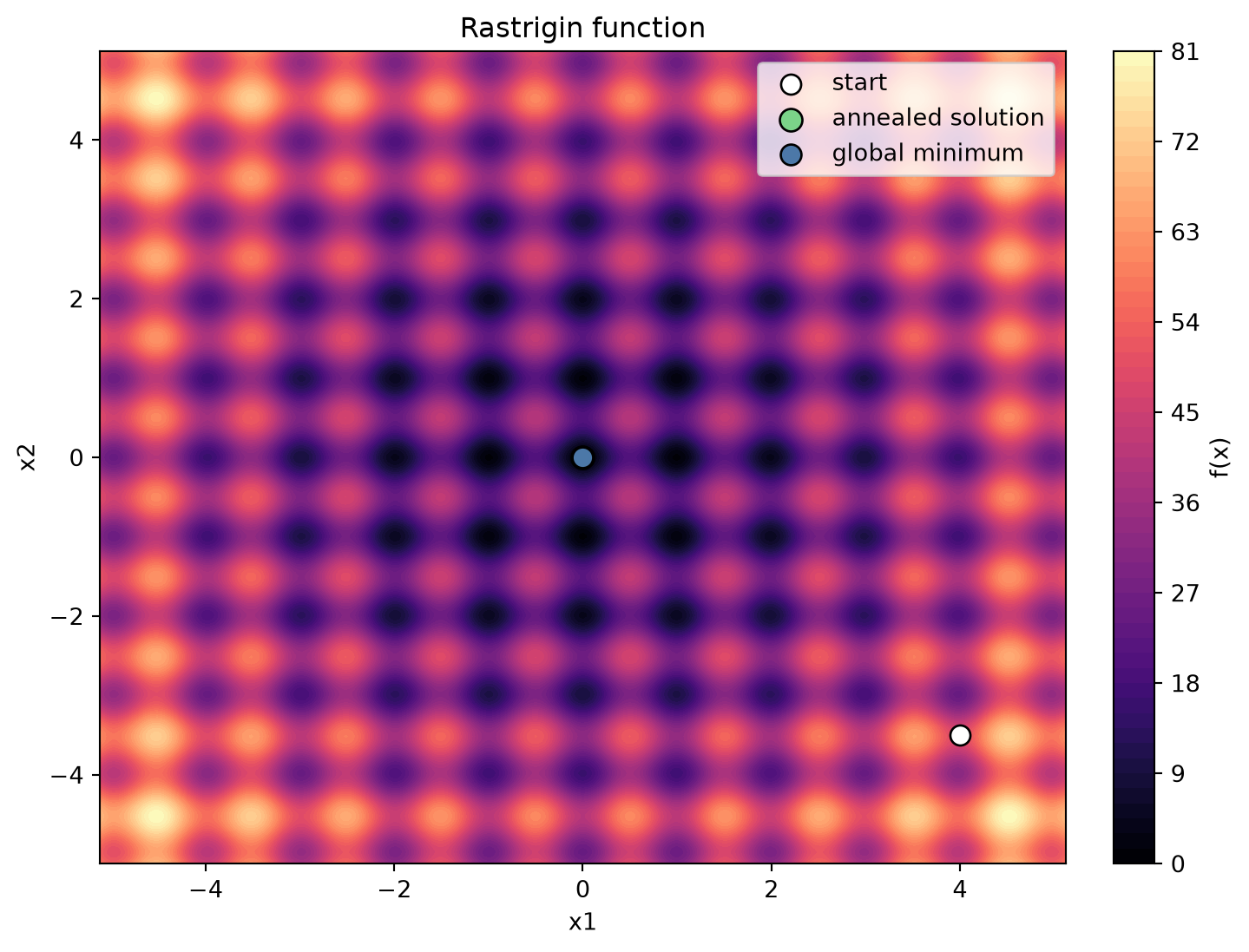
Here the annealer starts far from the origin and still finds a point essentially on top of the global solution. It is slower and noisier than the deterministic methods above, but it is solving a different problem: escaping local traps rather than exploiting a smooth local basin.
5 Takeaway
- Use
Optimizers.minimize_bfgsorOptimizers.minimize_lbfgsfor smooth likelihood-style objectives when you can write a stable gradient. - Use
Optimizers.minimize_nonlinear_cgwhen memory is tighter and you still have a reliable gradient for a smooth but awkward surface. - Use
Optimizers.minimize_simulated_annealingwhen the real problem is multimodality rather than local curvature.
These wrappers are intentionally low-level. They are the right tool when you want to build a custom estimator, a GMM objective, or a likelihood that the package does not yet expose as a first-class model.