Show code
import matplotlib.pyplot as plt
import numpy as np
import pandas as pd

np.set_printoptions(precision=4, suppress=True)Neyman repeated-sampling inference in randomized experiments
Chapter 4 shifts from Fisher’s sharp-null logic to Neyman’s repeated-sampling logic. The finite population is fixed and the treatment assignment is repeatedly redrawn.
import matplotlib.pyplot as plt
import numpy as np
import pandas as pd
np.set_printoptions(precision=4, suppress=True)rng = np.random.default_rng(4)
n = 100
n1 = 60
n0 = n - n1
truth = 1.0
base = rng.exponential(scale=1.0, size=n)
y0_constant = np.sort(base)[::-1]
y1_constant = y0_constant + truth
y0_negative = np.sort(base)
y1_negative = y1_constant.copy()
y0_independent = rng.permutation(y0_constant)
y1_independent = y1_constant.copy()
scenarios = {
"Constant effect": (y0_constant, y1_constant),
"Negative correlation": (y0_negative, y1_negative),
"Independent": (y0_independent, y1_independent),
}
def one_assignment(y0, y1, rng):
z = np.zeros(n)
z[rng.choice(n, size=n1, replace=False)] = 1.0
y = z * y1 + (1.0 - z) * y0
tau_hat = y[z == 1.0].mean() - y[z == 0.0].mean()
v_hat = y[z == 1.0].var(ddof=1) / n1 + y[z == 0.0].var(ddof=1) / n0
covered = abs(tau_hat - truth) <= 1.96 * np.sqrt(v_hat)
return tau_hat, v_hat, covered
rows = []
mc = 2000
draw_store = {}
for label, (y0, y1) in scenarios.items():
draws = np.array([one_assignment(y0, y1, rng) for _ in range(mc)])
draw_store[label] = draws
rows.append(
{
"scenario": label,
"empirical_var_of_tau_hat": draws[:, 0].var(ddof=1),
"average_neyman_var": draws[:, 1].mean(),
"coverage": draws[:, 2].mean(),
}
)
pd.DataFrame(rows).set_index("scenario")| empirical_var_of_tau_hat | average_neyman_var | coverage | |
|---|---|---|---|
| scenario | |||
| Constant effect | 0.051276 | 0.051232 | 0.9350 |
| Negative correlation | 0.012884 | 0.051822 | 1.0000 |
| Independent | 0.021289 | 0.051539 | 0.9965 |
The negative correlation case is where Neyman’s variance is most conservative, because treatment effects vary and Y(1) and Y(0) are moving against each other.
fig, axes = plt.subplots(3, 2, figsize=(10, 12))
grid = np.linspace(-0.8, 0.8, 200)

for row, (label, (y0, y1)) in enumerate(scenarios.items()):
    draws = draw_store[label]
    empirical_sd = np.sqrt(draws[:, 0].var(ddof=1))

    axes[row, 0].scatter(y0, y1, alpha=0.7)
    axes[row, 0].set_xlabel("$Y(0)$")
    axes[row, 0].set_ylabel("$Y(1)$")
    axes[row, 0].set_title(label)

    centered = draws[:, 0] - truth
    axes[row, 1].hist(centered, bins=40, density=True, alpha=0.75)
    normal = np.exp(-0.5 * (grid / empirical_sd) ** 2) / (np.sqrt(2.0 * np.pi) * empirical_sd)
    axes[row, 1].plot(grid, normal, color="black", linewidth=2.0)
    axes[row, 1].set_xlabel("$\\hat\\tau - \\tau$")
    axes[row, 1].set_title(f"{label}: repeated assignments")

fig.tight_layout()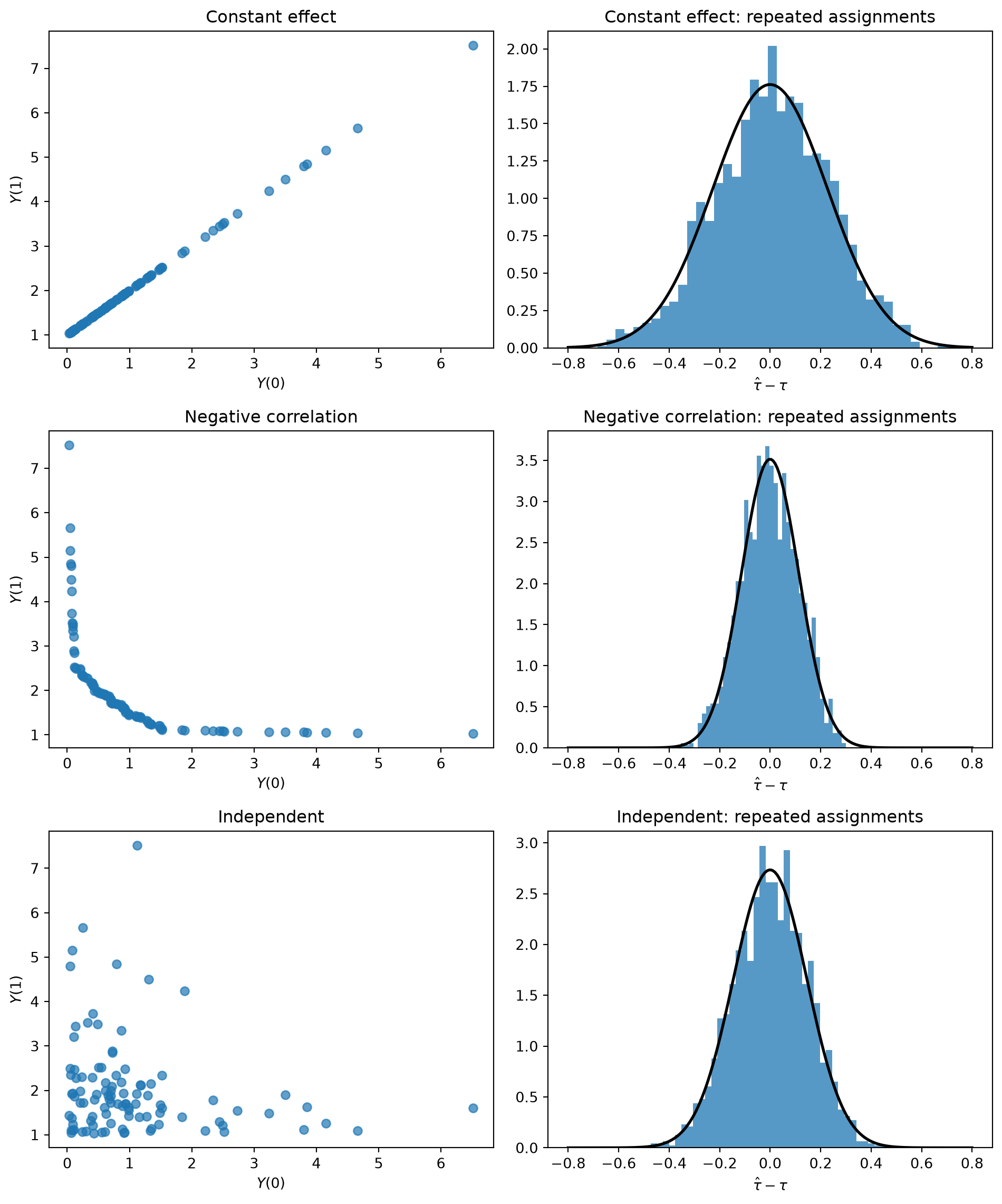
Chapter 4 is about repeated randomization with fixed potential outcomes. The Neyman variance estimator is conservative because the unit-level treatment-effect covariance term is unobserved, and the amount of conservatism depends on the finite-population geometry.