Show code
from pathlib import Path

import matplotlib.pyplot as plt
import numpy as np
import pandas as pd

import crabbymetrics as cm

np.set_printoptions(precision=4, suppress=True)


def expit(x):
return 1.0 / (1.0 + np.exp(-x))ATT estimation and balancing weights
Chapter 13 shifts attention from the ATE to the ATT. The R script computes outcome-regression, odds-weighted, and doubly robust ATT estimators. This page keeps those formulas and also shows the library-native balancing-weight version, because BalancingWeights directly targets the treated covariate distribution.
from pathlib import Path
import matplotlib.pyplot as plt
import numpy as np
import pandas as pd
import crabbymetrics as cm
np.set_printoptions(precision=4, suppress=True)
def expit(x):
return 1.0 / (1.0 + np.exp(-x))data = pd.read_csv(Path("../data/ding") / "nhanes_bmi.csv")
y = data["BMI"].to_numpy(dtype=float)
d = data["School_meal"].to_numpy(dtype=np.int32)
x = data[["age", "ChildSex", "black", "mexam", "pir200_plus", "WIC", "Food_Stamp", "AnyIns", "RefAge"]].to_numpy(dtype=float)
x = (x - x.mean(axis=0)) / np.where(x.std(axis=0) > 1e-12, x.std(axis=0), 1.0)
treated = d == 1
control = ~treated
reg0 = cm.OLS()
reg0.fit(x[control], y[control])
y0_hat = reg0.predict(x)
att_reg = float(y[treated].mean() - y0_hat[treated].mean())
reg_all = cm.OLS()
reg_all.fit(np.column_stack([d.astype(float), x]), y)
att_reg0 = float(reg_all.summary()["coef"][0])
logit = cm.Logit(alpha=1.0, max_iterations=300)
logit.fit(x, d)
logit_s = logit.summary()
pscore = expit(logit_s["intercept"] + x @ np.asarray(logit_s["coef"]))
odds = pscore / np.clip(1.0 - pscore, 1e-6, None)
nn = len(y)
nn1 = treated.sum()
res0 = y - y0_hat
att_ht = float(y[treated].mean() - np.mean(odds * (1 - d) * y) * nn / nn1)
odds_w = odds[control] / odds[control].sum()
att_odds = float(y[treated].mean() - np.dot(odds_w, y[control]))
att_dr = float(att_reg - np.mean(odds * (1 - d) * res0) * nn / nn1)
pscore_trunc = np.minimum(pscore, 0.9)
odds_trunc = pscore_trunc / np.clip(1.0 - pscore_trunc, 1e-6, None)
odds_trunc_w = odds_trunc[control] / odds_trunc[control].sum()
att_hajek_trunc = float(y[treated].mean() - np.dot(odds_trunc_w, y[control]))
att_dr_trunc = float(att_reg - np.mean(odds_trunc * (1 - d) * res0) * nn / nn1)
entropy = cm.BalancingWeights(
objective="entropy",
solver="auto",
autoscale=True,
l2_norm=0.02,
max_iterations=300,
tolerance=1e-8,
)
entropy.fit(x[control], x[treated])
entropy_s = entropy.summary()
att_entropy = float(y[treated].mean() - np.dot(np.asarray(entropy_s["weights"]), y[control]))
quad = cm.BalancingWeights(
objective="quadratic",
solver="auto",
autoscale=True,
l2_norm=0.02,
max_iterations=300,
tolerance=1e-8,
)
quad.fit(x[control], x[treated])
quad_s = quad.summary()
att_quad = float(y[treated].mean() - np.dot(np.asarray(quad_s["weights"]), y[control]))
pd.DataFrame(
{
"estimate": [
att_reg0,
att_reg,
att_ht,
att_odds,
att_dr,
att_hajek_trunc,
att_dr_trunc,
att_entropy,
att_quad,
]
},
index=[
"OLS coefficient on treatment",
"Outcome-regression ATT",
"HT odds-weight ATT",
"Hajek odds-weight ATT",
"Doubly robust ATT",
"Hajek ATT, pscore <= 0.9",
"DR ATT, pscore <= 0.9",
"Entropy-balancing ATT",
"Quadratic-balancing ATT",
],
)| estimate | |
|---|---|
| OLS coefficient on treatment | 0.048515 |
| Outcome-regression ATT | -0.362396 |
| HT odds-weight ATT | -1.830043 |
| Hajek odds-weight ATT | -0.380848 |
| Doubly robust ATT | -0.204772 |
| Hajek ATT, pscore <= 0.9 | -0.191598 |
| DR ATT, pscore <= 0.9 | -0.247166 |
| Entropy-balancing ATT | -0.193630 |
| Quadratic-balancing ATT | -0.304733 |
def standardized_mean_difference(x_treated, x_control, weights=None):
    mt = x_treated.mean(axis=0)
    if weights is None:
        mc = x_control.mean(axis=0)
        vc = x_control.var(axis=0)
    else:
        mc = np.average(x_control, axis=0, weights=weights)
        vc = np.average((x_control - mc) ** 2, axis=0, weights=weights)
    vt = x_treated.var(axis=0)
    scale = np.sqrt(0.5 * (vt + vc))
    scale = np.where(scale > 1e-12, scale, 1.0)
    return (mt - mc) / scale


smd_before = standardized_mean_difference(x[treated], x[control])
smd_entropy = standardized_mean_difference(x[treated], x[control], np.asarray(entropy_s["weights"]))
smd_quad = standardized_mean_difference(x[treated], x[control], np.asarray(quad_s["weights"]))

fig, ax = plt.subplots(figsize=(9, 4))
labels = [f"x{j + 1}" for j in range(x.shape[1])]
xpos = np.arange(len(labels))
width = 0.25
ax.bar(xpos - width, np.abs(smd_before), width=width, label="Unweighted")
ax.bar(xpos, np.abs(smd_entropy), width=width, label="Entropy")
ax.bar(xpos + width, np.abs(smd_quad), width=width, label="Quadratic")
ax.axhline(0.1, color="black", linestyle="--", linewidth=1.0)
ax.set_xticks(xpos)
ax.set_xticklabels(labels)
ax.set_ylabel("Absolute standardized mean difference")
ax.set_title("ATT balance before and after weighting")
ax.legend()
plt.tight_layout()
plt.show()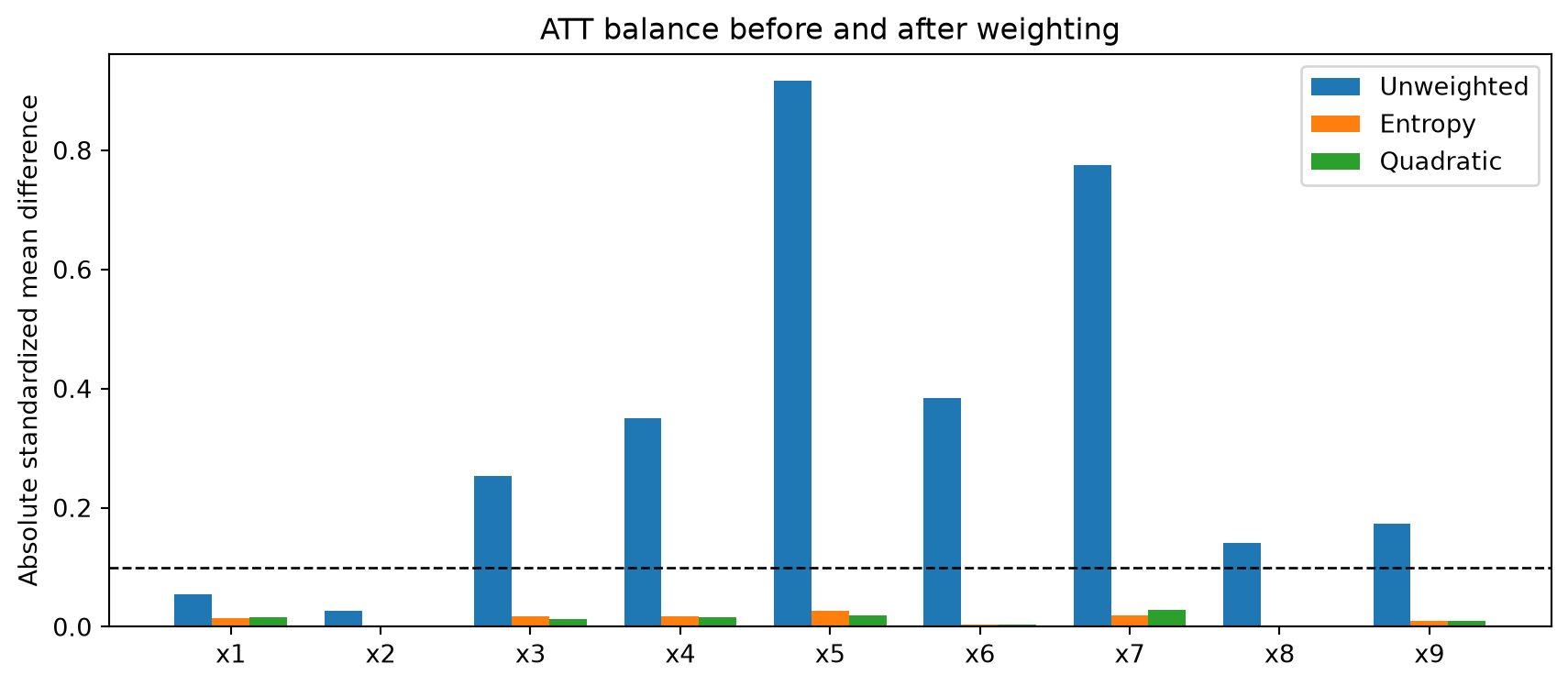
For ATT work, balancing weights are the clean library-native translation of the chapter. They target the treated population directly, which is exactly the estimand shift that Chapter 13 is about.