import matplotlib.pyplot as plt
import numpy as np

from crabbymetrics import KernelBasis, OLS, PCA

np.set_printoptions(precision=4, suppress=True)Richer Regression With Transformer Pipelines
The transformer classes are meant to sit in front of the regression estimators. This example uses a deliberately nonlinear data-generating process where raw OLS is badly misspecified, while a KernelBasis expansion followed by PCA compression and OLS fits the shape much better out of sample.
1 Generate A Nonlinear Regression Problem
rng = np.random.default_rng(2028)

n_train = 160
n_test = 500

x_train = rng.uniform(-2.5, 2.5, size=(n_train, 3))
x_test = rng.uniform(-2.5, 2.5, size=(n_test, 3))

def nonlinear_signal(x):
    return (
        1.2 * np.sin(1.5 * x[:, 0])
        + 0.7 * (x[:, 1] ** 2)
        - 0.8 * x[:, 0] * x[:, 1]
        + 0.5 * np.cos(1.2 * x[:, 2])
    )

y_train = nonlinear_signal(x_train) + rng.normal(scale=0.18, size=n_train)
y_test = nonlinear_signal(x_test) + rng.normal(scale=0.18, size=n_test)
2 Fit Three Models
# 1. Raw linear regression on the original design.
ols = OLS()
ols.fit(x_train, y_train)
pred_ols = ols.predict(x_test)

# 2. Linear PCA compression, then OLS.
linear_pca = PCA(2)
z_train_linear = linear_pca.fit_transform(x_train)
z_test_linear = linear_pca.transform(x_test)

ols_pca = OLS()
ols_pca.fit(z_train_linear, y_train)
pred_pca = ols_pca.predict(z_test_linear)

# 3. Nonlinear kernel basis, then PCA compression, then OLS.
kernel_basis = KernelBasis("gaussian", bandwidth=2.0)
z_train_kernel = kernel_basis.fit_transform(x_train)
z_test_kernel = kernel_basis.transform(x_test)

kernel_pca = PCA(24)
zk_train = kernel_pca.fit_transform(z_train_kernel)
zk_test = kernel_pca.transform(z_test_kernel)

kernel_regression = OLS()
kernel_regression.fit(zk_train, y_train)
pred_kernel = kernel_regression.predict(zk_test)

def mse(y_true, y_pred):
    return float(np.mean((y_true - y_pred) ** 2))

def r2(y_true, y_pred):
    return float(1.0 - np.sum((y_true - y_pred) ** 2) / np.sum((y_true - y_true.mean()) ** 2))

metrics = {
    "OLS": (mse(y_test, pred_ols), r2(y_test, pred_ols)),
    "PCA + OLS": (mse(y_test, pred_pca), r2(y_test, pred_pca)),
    "KernelBasis + PCA + OLS": (mse(y_test, pred_kernel), r2(y_test, pred_kernel)),
}

for name, (mse_value, r2_value) in metrics.items():
    print(f"{name:24s}  mse={mse_value:.4f}  r2={r2_value:.4f}")
OLS mse=5.3487 r2=0.0073
PCA + OLS mse=5.4468 r2=-0.0109
KernelBasis + PCA + OLS mse=1.0677 r2=0.8018Raw OLS and linear PCA + OLS only see linear combinations of the original regressors, so they cannot approximate the sinusoid, quadratic term, and interaction very well. The kernel pipeline first expands the design into a nonlinear similarity basis, then compresses it back down before fitting a regression.
3 Compare Held-Out Predictions
fig, axes = plt.subplots(1, 2, figsize=(12, 4.8), constrained_layout=True)

axes[0].scatter(y_test, pred_ols, s=16, alpha=0.55, color="#d95f02", label="OLS")
axes[0].scatter(y_test, pred_kernel, s=16, alpha=0.45, color="#1b9e77", label="Kernel pipeline")
axes[0].plot(
    [y_test.min(), y_test.max()],
    [y_test.min(), y_test.max()],
    color="0.25",
    lw=1.2,
)
axes[0].set_title("Held-out predictions")
axes[0].set_xlabel("True y")
axes[0].set_ylabel("Predicted y")
axes[0].legend(frameon=False)

x1_grid = np.linspace(-2.5, 2.5, 250)
slice_x = np.column_stack([x1_grid, np.zeros_like(x1_grid), np.zeros_like(x1_grid)])
true_slice = nonlinear_signal(slice_x)
ols_slice = ols.predict(slice_x)
kernel_slice = kernel_regression.predict(
    kernel_pca.transform(kernel_basis.transform(slice_x))
)

axes[1].plot(x1_grid, true_slice, color="black", lw=2.2, label="True signal")
axes[1].plot(x1_grid, ols_slice, color="#d95f02", lw=1.8, label="OLS")
axes[1].plot(x1_grid, kernel_slice, color="#1b9e77", lw=2.0, label="Kernel pipeline")
axes[1].set_title("1D slice with x2 = x3 = 0")
axes[1].set_xlabel("x1")
axes[1].set_ylabel("Predicted outcome")
axes[1].legend(frameon=False)

plt.show()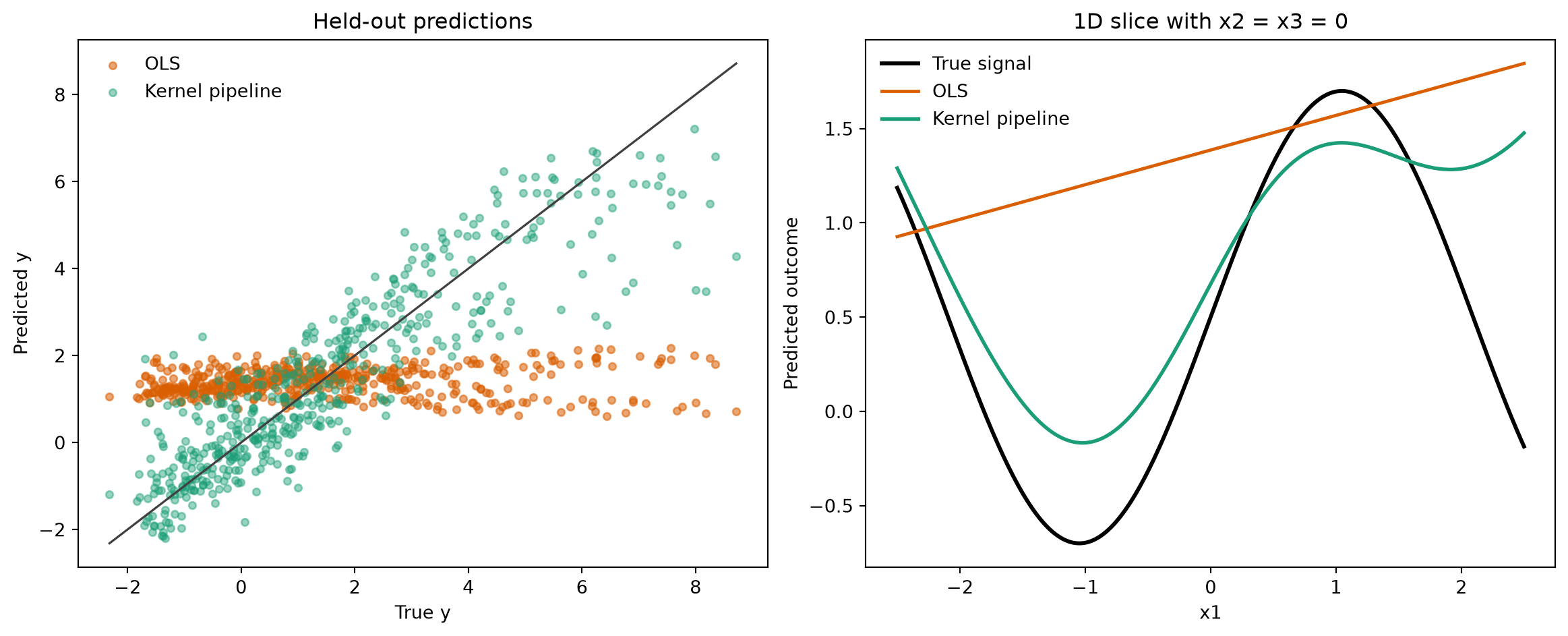
In this draw, the kernel-feature regression cuts held-out mean-squared error by a large margin relative to raw OLS. The point is not that KernelBasis replaces regular regression, but that it gives you a much richer right-hand side when the underlying response is smooth and nonlinear.