Show code
from pathlib import Path

import matplotlib.pyplot as plt
import numpy as np
import pandas as pd

import crabbymetrics as cm

np.set_printoptions(precision=4, suppress=True)


data_dir = Path("../data/ding")Regression adjustment and rerandomization
Chapter 6 combines two ideas that now look standard:
from pathlib import Path
import matplotlib.pyplot as plt
import numpy as np
import pandas as pd
import crabbymetrics as cm
np.set_printoptions(precision=4, suppress=True)
data_dir = Path("../data/ding")star = pd.read_stata(data_dir / "star.dta")
star = star.query("control == 1 or sfsp == 1").copy()
star["y"] = star["GPA_year1"].fillna(star["GPA_year1"].mean())
y = star["y"].to_numpy(dtype=float)
z = star["sfsp"].to_numpy(dtype=float)
x = star[["female", "gpa0"]].to_numpy(dtype=float)
xc = x - x.mean(axis=0, keepdims=True)
unadjusted = cm.OLS()
unadjusted.fit(z[:, None], y)
lin_design = np.column_stack([z, xc, z[:, None] * xc])
lin = cm.OLS()
lin.fit(lin_design, y)
pd.DataFrame(
{
"estimate": [
unadjusted.summary()["coef"][0],
lin.summary()["coef"][0],
],
"se_hc1": [
unadjusted.summary(vcov="hc1")["coef_se"][0],
lin.summary(vcov="hc1")["coef_se"][0],
],
},
index=["Unadjusted", "Lin-adjusted"],
)| estimate | se_hc1 | |
|---|---|---|
| Unadjusted | 0.051829 | 0.077367 |
| Lin-adjusted | 0.068166 | 0.073170 |
rng = np.random.default_rng(6)
n = 250
n1 = n // 2
x = rng.normal(size=(n, 2))
y0 = 0.6 * x[:, 0] - 0.4 * x[:, 1] + rng.normal(scale=0.7, size=n)
tau = 1.0 + 0.25 * x[:, 0]
y1 = y0 + tau


def diff_in_means(y, z):
    treated = z == 1.0
    control = ~treated
    return y[treated].mean() - y[control].mean()


def lin_estimate(y, z, x):
    xc = x - x.mean(axis=0, keepdims=True)
    design = np.column_stack([np.ones(len(y)), z, xc, z[:, None] * xc])
    beta, *_ = np.linalg.lstsq(design, y, rcond=None)
    return beta[1]


def imbalance_score(z, x):
    treated = z == 1.0
    control = ~treated
    diff = x[treated].mean(axis=0) - x[control].mean(axis=0)
    scale = x.std(axis=0, ddof=1)
    return float(np.sum((diff / scale) ** 2))


def draw_assignment(rng, rerandomize=False, threshold=0.08):
    while True:
        z = np.zeros(n)
        z[rng.choice(n, size=n1, replace=False)] = 1.0
        if (not rerandomize) or imbalance_score(z, x) <= threshold:
            return z


mc = 400
records = []
for design_name, rerand in [("Complete randomization", False), ("Rerandomization", True)]:
    for _ in range(mc):
        z_draw = draw_assignment(rng, rerandomize=rerand)
        y_obs = z_draw * y1 + (1.0 - z_draw) * y0
        records.append(
            {
                "design": design_name,
                "diff_in_means": diff_in_means(y_obs, z_draw),
                "lin_adjusted": lin_estimate(y_obs, z_draw, x),
                "imbalance": imbalance_score(z_draw, x),
            }
        )

sim = pd.DataFrame(records)
sim.groupby("design")[["diff_in_means", "lin_adjusted", "imbalance"]].agg(["mean", "std"])| diff_in_means | lin_adjusted | imbalance | ||||
|---|---|---|---|---|---|---|
| mean | std | mean | std | mean | std | |
| design | ||||||
| Complete randomization | 0.989575 | 0.133870 | 0.993991 | 0.078156 | 0.032905 | 0.033030 |
| Rerandomization | 0.993091 | 0.127354 | 1.003287 | 0.086698 | 0.024838 | 0.020134 |
fig, axes = plt.subplots(1, 2, figsize=(10, 4))
for ax, column, title in zip(
    axes,
    ["diff_in_means", "lin_adjusted"],
    ["Unadjusted estimator", "Lin-adjusted estimator"],
):
    for label, df in sim.groupby("design"):
        ax.hist(df[column], bins=35, alpha=0.55, label=label)
    ax.axvline(tau.mean(), color="black", linestyle="--", linewidth=2.0)
    ax.set_title(title)
    ax.legend()
fig.tight_layout()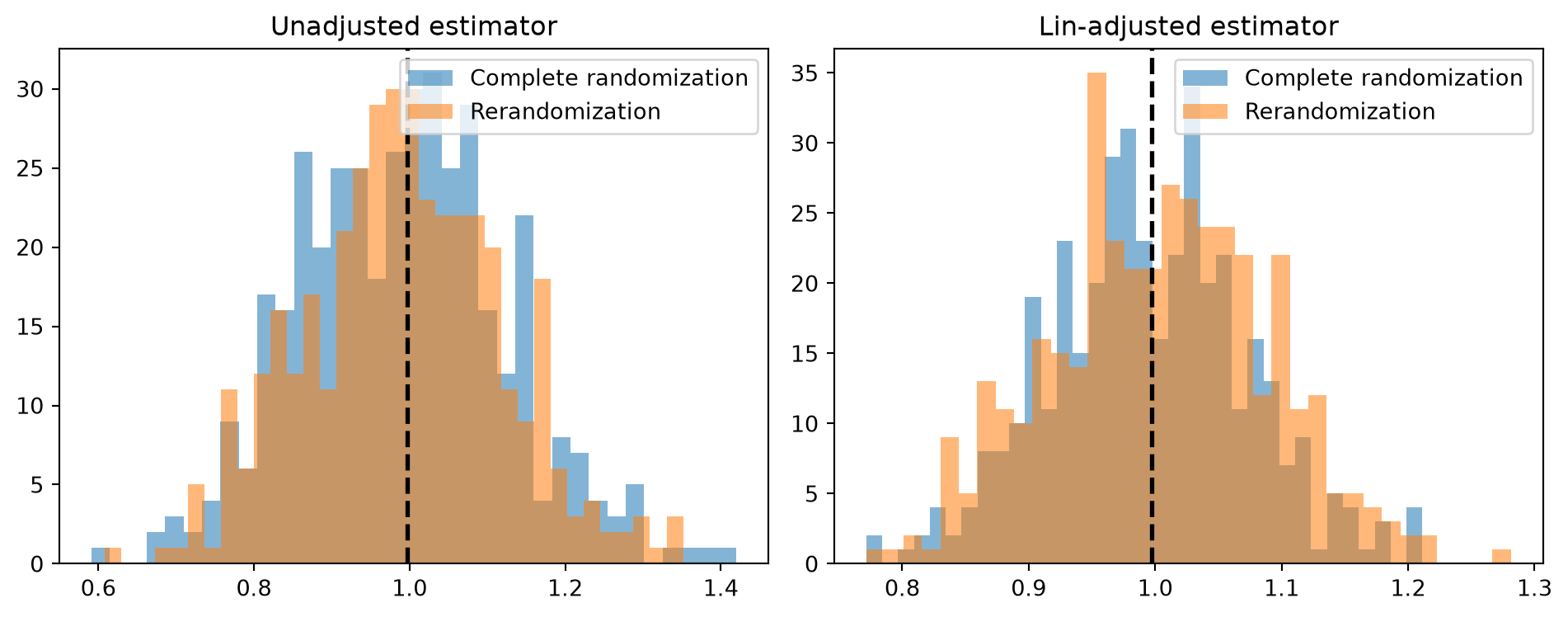
Lin adjustment and rerandomization are doing different jobs:
Both tend to reduce finite-sample noise when the covariates are prognostic.