Show code
import math

import matplotlib.pyplot as plt
import numpy as np

np.set_printoptions(precision=4, suppress=True)Fisherian versus Neymanian inference
The full chapter studies several studentized statistics. This translation keeps the core contrast: when treatment effects are heterogeneous, the Neyman average-null and the Fisher sharp-null need not lead to the same finite-sample p-values.
import math
import matplotlib.pyplot as plt
import numpy as np
np.set_printoptions(precision=4, suppress=True)rng = np.random.default_rng(8)
n = 24
n1 = n // 2
x = np.linspace(-1.0, 1.0, n)
y0 = -x + rng.normal(scale=0.25, size=n)
tau = 1.5 * x
y1 = y0 + tau
def diff_in_means(y, z):
treated = z == 1.0
control = ~treated
return y[treated].mean() - y[control].mean()
def normal_pvalue(stat):
return math.erfc(abs(float(stat)) / math.sqrt(2.0))
def neyman_pvalue(y_obs, z_obs):
treated = z_obs == 1.0
control = ~treated
tau_hat = diff_in_means(y_obs, z_obs)
se_hat = np.sqrt(y_obs[treated].var(ddof=1) / treated.sum() + y_obs[control].var(ddof=1) / control.sum())
return normal_pvalue(tau_hat / se_hat)
def fisher_pvalue(y_obs, z_obs, rng, n_frt=2000):
tau_hat = diff_in_means(y_obs, z_obs)
null_stats = np.zeros(n_frt)
for draw in range(n_frt):
z_null = np.zeros(n)
z_null[rng.choice(n, size=n1, replace=False)] = 1.0
null_stats[draw] = diff_in_means(y_obs, z_null)
return float(np.mean(np.abs(null_stats) >= abs(tau_hat)))
fisher_draws = []
neyman_draws = []
for _ in range(80):
z = np.zeros(n)
z[rng.choice(n, size=n1, replace=False)] = 1.0
y_obs = z * y1 + (1.0 - z) * y0
neyman_draws.append(neyman_pvalue(y_obs, z))
fisher_draws.append(fisher_pvalue(y_obs, z, rng))
print("Mean Neyman p-value:", round(float(np.mean(neyman_draws)), 4))
print("Mean Fisher p-value:", round(float(np.mean(fisher_draws)), 4))
print("Share Neyman <= 0.05:", round(float(np.mean(np.asarray(neyman_draws) <= 0.05)), 4))
print("Share Fisher <= 0.05:", round(float(np.mean(np.asarray(fisher_draws) <= 0.05)), 4))Mean Neyman p-value: 0.7301
Mean Fisher p-value: 0.7328
Share Neyman <= 0.05: 0.0
Share Fisher <= 0.05: 0.0fig, axes = plt.subplots(1, 2, figsize=(10, 4))
axes[0].hist(neyman_draws, bins=20, density=True, alpha=0.8)
axes[0].axhline(1.0, color="black", linestyle="--", linewidth=1.2)
axes[0].set_title("Neyman p-values")
axes[0].set_xlabel("p-value")
axes[1].hist(fisher_draws, bins=20, density=True, alpha=0.8)
axes[1].axhline(1.0, color="black", linestyle="--", linewidth=1.2)
axes[1].set_title("Fisher p-values")
axes[1].set_xlabel("p-value")
plt.tight_layout()
plt.show()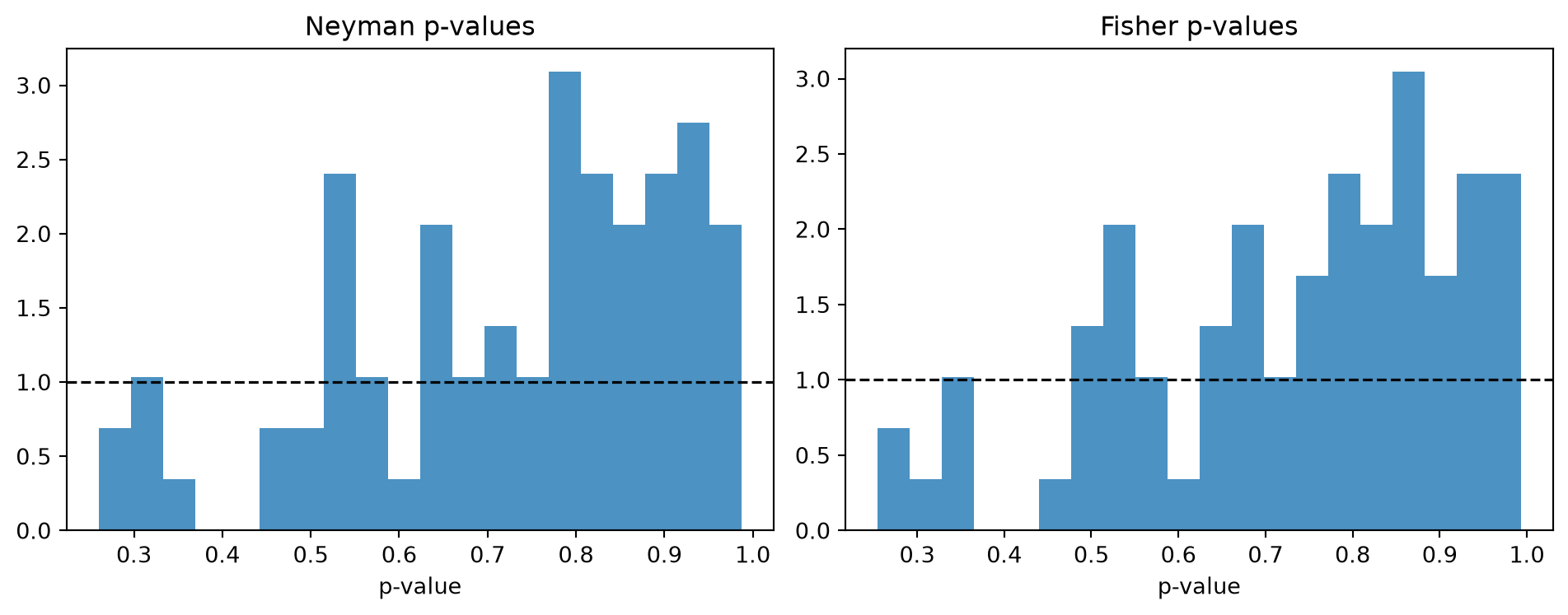
Here the finite-population average treatment effect is close to zero, so Neyman’s null is plausible. Fisher’s sharp null is false because the unit-level treatment effects vary with x. The resulting p-value distributions do not line up perfectly, which is exactly the point of the chapter.